










1. Introduction What Short-Range Detection Is “After”
“Short-range detection” is often misunderstood as “since the distance is not far, the requirements are not high.” But in parking and blind-zone assistance scenarios, it is the opposite: the challenges often concentrate in the decision window closer to the vehicle—when information arrives late, the judgment is unstable, or it fails under boundary conditions, collision risk can be directly amplified.
1.1 Typical Scenarios for Short-Range Detection
In in-vehicle near-field tasks, ultrasonic sensors have long taken on two core responsibilities:
Obstacle detection in parking / low-speed reversing scenarios The engineering process behind parking assistance is essentially “transmit—receive—judge”: after the ultrasonic signal is emitted, the receiving end detects the reflected echo from obstacles, confirms the presence of an object via the echo, and further measures the obstacle distance. When the vehicle performs steering and posture adjustments, the distance information needs to be continuously updated and used in a closed-loop control.
Blind-zone assistance (blind-zone / blind-spot detection) When a target is outside the driver’s field of view, but is still close enough to affect vehicle safety, the system must reach a reliable conclusion in a shorter time: whether there is an obstacle nearby and approximately how far it is. Ultrasonic advantages lie in the fact that the working mechanism allows the system to make distance and presence judgments based on the echo, forming the basic sensing input for alerts and assistance decisions.

Summary: Short-range detection is not about “measuring farther,” but about outputting distance and presence information earlier, more stably, and more repeatably.
1.2 Why Focus on “Ultrasonics Suited for Short-Range”
To answer “why ultrasonics are suitable for short range,” you usually cannot simply say “it can measure distance.” More critical is that the physics and system link of ultrasonics match the “metrics combination” of short-range tasks, mainly reflected in the following:
-
It uses echo time and reflection to perform distance/presence judgment
Ultrasonic sensors/transducers can serve short-range tasks through two core capability paths:- Use reflections for distance detection;
- Use the fluctuation characteristics of ultrasonic waves for presence detection.
-
The active measurement mechanism reduces the risk of “light-dependence” failure
Many near-field tasks share a common background: the environment is complex (nighttime, backlighting, sudden changes in illumination). Ultrasonics are an active acoustic measurement path: the system relies on reflected echoes and timing extraction rather than relying on the image quality of visible light. Therefore, it is easier to maintain usability in such scenarios (engineering still needs to pay attention to acoustic propagation and mounting geometry, but the failure mechanism differs from that of optical sensing). -
The impact of target surface attributes on echo usability is usually more controllable
Near-field obstacles often include a variety of materials and surface conditions. Basic reference materials indicate that, in distance detection applications, ultrasonic sensing has better adaptability to target features such as transparent plastics and glass compared with optical distance measurement. For the diversity of real obstacles outside the vehicle body, this directly affects the system’s stability under “common but complex” real-world conditions. -
Mature industry and system implementation pathways make near-field mass production feasible
Parking assistance systems need to turn ultrasonics’ “measure—judge—use” into a closed loop: transmit ultrasonic signals, receive reflected waves, confirm presence, measure distance, and then provide the results to the control system. TDK’s application materials clearly describe the working logic of ultrasonic parking assistance and its continuity into automatic parking capabilities—this also indirectly shows that ultrasonics can form a mature engineering implementation route in near-field tasks.
2. Engineering Metric Breakdown for Short-Range Detection
The key to short-range detection is not whether “the range is very long,” but whether a set of metrics can form stable decisions in the near end. The system needs to detect earlier, update faster, and have fewer false alarms and missed detections, while also maintaining consistency across multiple sensors and complex environments.
2.1 Detection Distance / Coverage Capability (from near to far)
First, coverage capability must answer two questions:
-
Is near-end coverage sufficient?
In parking / blind-zone detection, what truly determines the safety margin is “how early the usable range is entered.” Once a near-end target falls into the blind-zone boundary, it may shift from “identifiable” to “identification is unstable.” -
Does coverage remain consistent with changes in vehicle posture?
For the same obstacle, as the vehicle approaches and steers, the relative angle changes. Coverage capability includes not only “maximum distance,” but also how sound-beam coverage and echo usability vary. Engineering requirements are typically converted into: within the specified near-range distance segment, the system should have a sufficient probability of acquiring decidable echoes (rather than detecting them only occasionally).
2.2 Blind Zone and Minimum Resolvable Distance
“Blind zone” is often one of the most sensitive metrics in short-range systems, because it corresponds to when the system starts producing reliable outputs.
Typical causes of blind zones: the effects of transmit/receive switching (T/R management), reception threshold and time window settings, sound-beam geometry, and mounting position, which together cause echo signals in a certain near-range interval to be either too weak or drowned out by noise/interference.
Minimum resolvable distance (often tied to near-end resolution capability): when the obstacle distance changes only slightly, can the system distinguish “slightly closer / slightly farther” through continuous updates? This directly affects the fineness of parking strategy and the stability of alert thresholds.
Practical advice: when selecting, do not only look at single-point metrics such as “minimum range” / “minimum value of blind zone.” You should also ask how it performs with multiple targets, installation tolerances, and the vehicle’s motion state.
2.3 Distance Accuracy / Resolution (Impact on Parking Planning and Collision Risk)
In short-range systems, “accuracy” and “resolution” both fall under distance-measurement capability, but they affect different parts of the chain:
Resolution is more like whether the system can distinguish adjacent distance differences. For parking / approaching obstacles, it determines whether the system’s output distance curve is smooth and whether it will jump back and forth at the boundary.
Accuracy is more like the error range of repeated measurements for the same true distance. It determines whether the safety margin needs extra redundancy, and thus affects how conservative the control strategy must be.
Ultrasonic sensor advantages lie in the fact that it establishes a correspondence between obstacle reflected echoes and flight time, thereby providing an interpretable measurement chain for distance output; however, the final accuracy/resolution still depends on echo extraction and the signal-chain processing capability.
2.4 Refresh Rate / Response Latency (Determines Whether the System Can Keep Up)
Short-range detection is typically used in scenarios with low speed but rapid changes: starting to reverse, adjusting steering angle, changes in vehicle body posture, and so on.
Therefore, these two “time metrics” are critical:
- Refresh rate: how many usable measurement results can be output per second.
- End-to-end latency: the total time from transmit triggering to distance/state output (including reception, sampling, processing, computation, and communication).
If the latency is too large or the refresh rate is insufficient, two consequences can occur:
- The control closed loop cannot keep up, making planning “lag behind.”
- The system becomes more dependent on prediction/filtering, leading to reduced response consistency in boundary scenarios.
2.5 Interference Immunity in Parallel Operation of Multiple Sensors (Same-vehicle same-frequency / crosstalk)
When multiple probes on the same vehicle work in parallel, the most common issue in short-range systems is often not that “a single sensor is not working,” but that “the system affects each other at the system level.”
You need to focus on evaluating:
Whether crosstalk will break the echo’s decidability (for example, when non-target reflections appear in the echo window, or echoes are interfered with across sensors).
Whether there is a clear transmit/receive timing strategy (polling, synchronization/offset, etc.).
Whether the frequency/modulation strategy is effective for multiple channels on the same vehicle; for example, reducing co-frequency interference risk via different frequency points or encoding.
In engineering materials, the ultrasonic sensor AFE/signal chain is often used for echo processing and diagnostics and supports configurability. Such capability is important for multi-channel coordination and abnormality identification.
2.6 Environmental Robustness (Insensitive to light ≠ No impact in all scenarios)
The short-range vehicle environment is complex, so robustness evaluation needs to cover two layers:
Acoustic link level: the impact of temperature/humidity and variations in the speed of sound on distance conversion; acoustic airflow disturbances; and multipath reflections and echo distortion caused by road surfaces and obstacle shapes.
System decision level: echo quality evaluation, adaptive thresholds, and output strategies for fault/unmeasurable states (avoid treating an “unmeasurable” condition as a “wrong distance”).
Basic reference materials often emphasize that ultrasonics rely on the echo reflection mechanism rather than visible-light imaging logic, and therefore can be used reliably in nighttime and backlighting scenarios. However, ultimate stability is still determined by the system’s echo processing and decision strategies.
3. Ultrasonic Working Principle: How It Turns “Echoes” Into “Distance and Presence”
In short-range tasks, what the system truly “sees” is not the obstacle itself, but the echo that the obstacle reflects back toward ultrasonics. Therefore, the core value of ultrasonic ranging is: converting measurable echo information reliably into usable distance (Distance) and presence/target state (Presence/Existence).
3.1 Basic Logic of Flight Time / Echo Reflection (ToF Concept)
In engineering, the most common approach for ultrasonic distance measurement is “Time of Flight (ToF)”:
- The transmitter emits a burst of ultrasonic pulses outward;
- The signal propagates to the target and reflects;
- The receiver receives the reflected echo;
- The system measures the time difference from “transmit to receive”;
- It converts this using the speed of sound to obtain distance.
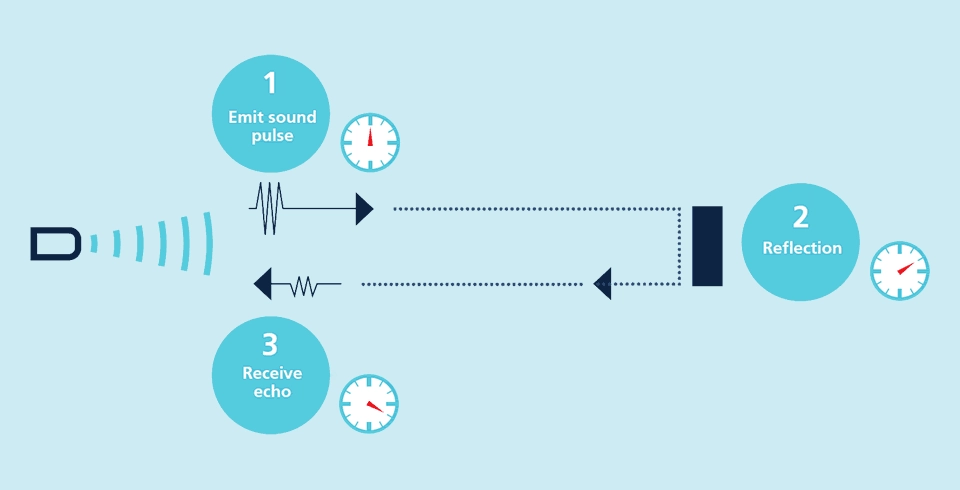
Under ideal conditions, this process forms a relatively direct “time—distance” correspondence: the earlier the echo arrives, the closer the distance; the later the echo arrives, the farther the distance. The short-range task’s high suitability comes precisely from the fact that targets typically form more critical echo characteristics within a shorter time window, allowing the system to enter a stable decision workflow sooner.
3.2 Transducer and Signal Chain: From Transducer to AFE/MCU
To compute the echo accurately, it relies not just on simple pulse transmission, but on a complete receive signal chain and timing management. Typical structures include:

Transducer: responsible for converting electrical signals into ultrasonic waves, and also converting reflected echoes back into processable electrical signals;
AFE / Analog Front-End: amplifies, filters, and samples the received weak echoes, and performs trigger/time-related processing;
MCU / Processing Unit: performs echo feature extraction, distance computation, and state judgment, and carries out diagnostics and configuration management.
From a system-architecture perspective, the significance of the AFE is that echoes are often very weak and noisy signals, and “decidability-enabling processing” must be completed within the correct time window. ultrasonic sensor AFE, explicitly mentions that its configurable ultrasonic AFE includes a built-in digital signal processor (DSP) and built-in diagnostic functions, used to adapt to different system requirements and to incorporate echo processing and diagnostic capabilities into the same chain. This is especially critical for automotive-grade systems: it means the system is not only outputting a distance value, but also judging whether “this measurement is trustworthy.”
3.3 Why Ultrasonics Can Do “Distance Detection + Presence Detection”
Many readers equate ultrasonics with “measuring distance.” But for short-range detection, presence detection is equally important, because it determines whether the system can enter the “target present / target absent” state management before the target provides complete distance information.
Ultrasonic sensor capabilities follow clear paths:
Ultrasonic waves can be used for distance detection via reflections;
They can also be used for presence detection based on ultrasonic fluctuation characteristics;
And in distance-detection use cases, compared with optical distance measurement, ultrasonics can detect target characteristics such as transparent plastics and glass.
In engineering implementation, it becomes:
Distance detection depends more on the echo arrival time and the stability of the echo waveform;
Presence detection depends more on the system’s decision logic about whether a “target echo” appears and whether it matches expectations for the acoustic scene (for example, echo energy, timing position, frequency-band characteristics, etc.).
Short-range scenarios often require both types of information at the same time: presence detection is used to enter alert/decision states faster, while distance detection is used for more precise parking control and for computing near-end safety margins. Only when both are combined does it form a truly usable sensing closed loop for parking and blind-zone assistance.
4. Core Argument: Why Ultrasonics Are Especially Suitable for “Short-Range Detection”
The reason short-range detection often “relies more on system capability” is that obstacles are close, and usable information is often contained in a smaller time window. Meanwhile, near-range errors convert into control risk faster. Therefore, “is it suitable or not” is not judged by whether ultrasonics can measure distance; instead, it is judged by whether it can be more stable and consistent in near-end echoes, environmental adaptability, and system implementation.
4.1 Near-End Signal Characteristics Help Enable Stable System Decisions
One key engineering point in short-range scenarios is that the system is more likely to separate the “target echo” from noise, sidelobe echoes, and interfering echoes—making threshold decisions, flight-time measurement, and state updates more stable.
In the ultrasonic ranging chain, the system usually needs to do the following:
Within the receive window, locate the time position of the “valid echo”;
Evaluate the quality of echo amplitude and waveform shape;
Map the time position to distance and output presence/distance status.
Near-end target echoes often become the primary source of decision information: on the one hand, the echo arrival time falls into a more concentrated and predictable time window; on the other hand, the system can design detection thresholds and processing strategies around near-end key regions, increasing “decidability.” For parking and blind-zone assistance, this corresponds to more controllable near-end alerts and smoother distance-curve outputs (reducing jumps and misjudgments in boundary states).
4.2 Doesn’t Depend on Ambient Light: Still Works at Night and in Strong Backlight
Image/vision sensors are more sensitive to changes in lighting conditions; strong backlight, glare, or insufficient local illumination can significantly affect recognition quality. In comparison, ultrasonics are active acoustic sensing: the system emits ultrasonic waves and receives reflected echoes—the working mechanism does not use “visible textured scene information” as the primary information source.
Therefore, the usability of ultrasonic ranging can remain more consistent in nighttime, tunnels, and backlight scenarios. Engineering notes: it still depends on acoustic propagation conditions and the target’s reflective characteristics, but its failure mechanism differs from optical sensing—this matches the “need for stable and usable operation” demanded by parking/near-field blind-zone tasks.
4.3 Less Affected by Material / Color / Transparency (Friendly to “Real Obstacle Diversity”)
Obstacles outside the vehicle in the real world are highly “non-ideal.” The material may be metal, plastic, or composite materials; the surface may have different reflection/absorption properties; and some targets may also lack stable textures in visible-light imaging.
Ultrasonics’ advantage is that it mainly relies on sound-wave propagation and reflected echoes. Public reference materials describing ultrasonic capabilities emphasize that ultrasonics can be used for distance detection and presence detection, and when used for distance detection, compared with optical ranging, ultrasonics can detect target features such as transparent plastics and glass.
Applied to short-range parking / blind-zone detection, this means that for the same “near obstacle,” the system is more likely to maintain detectability under different material and surface conditions, thereby improving robustness and consistency in near-field scenarios.
4.4 Mature System Implementation: The Engineering Path for Parking Assistance and Blind-Zone Detection
Whether short-range detection can truly be deployed ultimately depends on whether the system can form a closed loop under mass-production cost, calibration/testing cycle, and reliability requirements.
A key logic for ultrasonic parking assistance: the system confirms object presence by transmitting and receiving reflected waves from obstacles, and it measures the obstacle distance. This means the “measure—judge—use” chain in ultrasonic parking assistance has already formed clear engineering practice: from echo acquisition to distance/presence output, and then to system decision-making and control coordination.
When a sensing technology can form a mature chain for its target task, its adaptability to short-range scenarios becomes more controllable. You do not have to solve measurement inaccuracy from scratch; instead, you focus on decision strategy for near-end boundaries, crosstalk mitigation, and system-level diagnostic reliability.
5. Engineering Deployment: How to Mount Multiple Ultrasonic Probes to Make Them “Controllable in the Near Field and Usable Against Interference”
You can think of a multi-probe ultrasonic system as: the vehicle has many “sound-emitting detectors.” Their goal is, in close-range scenarios such as reversing/parking, to tell you as reliably and consistently as possible: where there is something and how far it is.
To achieve this, the most critical point in deployment is not “how strong one probe is,” but ensuring that the whole system does not influence each other in near-field work, and does not output wildly varying results.
5.1 Why Multiple Probes Are Needed: One Probe Can’t See “Angle”
If there is only one ultrasonic probe, it can only be relatively good at judging “how far away it is,” but it is difficult to reliably determine whether the “object is on my left or on my right.” Therefore, multiple probes are usually installed on the front and rear and/or sides of the vehicle, so the system can piece together a more complete picture of the surrounding environment.
In practical automotive-grade implementations, a common approach is: place multiple ultrasonic probes on the front and rear bumpers (many systems use 4 to 8 probes to cover the surrounding area). The meaning of multiple probes is to make the “direction information in the near field” more stable—so you avoid having only one line of distance data that cannot guide parking actions.

5.2 How to “Mount” Probes: Position Determines Coverage Area and Also Determines Where the Blind Zones Are
Ultrasonic probes themselves have a “coverage angle.” For example, in common descriptions: in the horizontal direction, they can cover roughly about 120°; in the vertical direction, roughly about 60° (there will be slight differences across vehicle models and structures).
So engineering deployment typically does two things:
- Mount the probes at suitable heights/angles: so that critical blind zones (for example, the lower rear area and near-side corners) are covered as much as possible;
- Ensure the coverage regions of each probe complement each other: avoid “no one is looking at this part.”
You can summarize it in a more intuitive sentence in the text: the probe placement is not to “see more,” but to “see just enough.”
5.3 The Essence of “Interference Immunity”: Make Probes Not Mistake Each Other’s Echoes
When multiple probes work at the same time, the most common problem can be summarized in plain language: I’m waiting for an echo, but I might also receive someone else’s transmitted sound—or sound that hasn’t decayed cleanly yet.
Ultrasonic probes, due to structural reasons, can have residual vibration. Therefore, parking systems generally become difficult to make stable judgments at very short distances (for example, on the order of 20–30 cm). The system may not be able to distinguish “is it an echo or residual vibration,” and as a result the alert behavior becomes unreliable.
In engineering, the “interference immunity” deployment actions are usually these ideas (you don’t have to write them too rigidly for readers):
- Alternate operation / staggered sound emission: have different probes transmit at different times to reduce mutual disturbance;
- Control the receive timing: only “listen seriously” within a reasonable time window—listening too early or too late may pick up noise;
- Pair with software decision logic: when the echo waveform is not similar enough to an “effective target,” reduce confidence or mark it as unavailable.
You don’t need to expand on complex algorithms in the text, but you can emphasize that interference immunity is not achieved by a single probe being “stronger,” but by the combination of “sound-emission rhythm + receive timing + decision rules.”
5.4 Make the Output “Steady”: Even with More Probes, Ensure Boundaries Don’t Jump
The final step is the product experience. Even if the system can measure distance, it should avoid situations such as:
- Sudden false alarms when the target is very close;
- Distance oscillating back and forth at the boundary, causing the parking strategy to not dare to use it or to be overly conservative.
5.5 From “Measuring Distance” to “Using with Confidence”: Turn the Result Into Vehicle Actions
By now, we have explained why ultrasonics can work in near-field, and how multiple probes reduce mutual influence. But in real use, what users care about most is whether the system’s information can stably guide the next action.
Therefore, engineering deployment typically needs to do two more things to “make the result usable”: Convert the distance result into usable judgments—for example, “whether there is an obstacle nearby, and how close it is,” rather than outputting a single value that is easy to oscillate; Make the system more conservative and consistent at boundaries: when measurements become unreliable, alerts and parking prompts should reflect “I’m not sure / I need to be more cautious,” rather than hard-coding a conclusion that looks certain but may mislead. In one sentence: the sensor is responsible for “seeing,” while the system is responsible for “making the result usable.”
Conclusion
In summary, the reason in-car ultrasonic sensors are especially suitable for short-range detection is not that they “measure farther,” but that in key scenarios such as parking and blind zones, they can provide obstacle information that is earlier, more stable, and easier for the system to continuously update.
At the engineering level, near-field usability comes from two main lines: first, the sensing mechanism matches short-range tasks (echo-driven distance and presence judgment); second, probe placement and interference-mitigation strategies help the system output stay less “unstable” in complex environments, and boundary scenarios become more controllable. Ultimately, what ultrasonics deliver to users should not be a “seemingly precise” number, but a reliable sensing result that helps the vehicle make the right decision at critical moments and reduce risk.
FAQ
Q1: Why are in-car ultrasonic sensors suitable for short-range detection?
A1 : Because short-range tasks like parking and blind-spot assistance benefit from stable, repeatable proximity sensing—ultrasonic systems actively emit sound and measure return echoes to provide presence and distance information within the near-field decision window.
Q2: Does “short-range” mean the system doesn’t need high performance?
A2 : Not at all. In near-field driving, reliability matters most: early detection, consistent output, and fewer boundary-case failures are what directly affect safety and user trust.
Q3: What main functions do ultrasonic sensors support in short-range scenarios?
A3 : Typically two things: (1) obstacle presence detection (whether something is near) and (2) distance measurement (how far it is), which together support parking guidance and near-field safety logic.
Q4: How does an ultrasonic sensor turn an echo into distance?
A4 : It sends an ultrasonic pulse, then measures the time of flight (ToF) from emission to echo reception; the system converts this time into distance using the speed of sound and echo timing logic.
Q5: Why is “presence detection” important in addition to distance?
A5 : Near-range systems often need a quick and robust existence/not-existence state to trigger alerts and control decisions. Distance then refines the boundary and trajectory guidance.
Q6: Can ultrasonic sensing still work well at night or in tunnels?
A6 : Yes—ultrasonic sensing is not dependent on lighting conditions like cameras. Since it is an active acoustic method, it’s generally less affected by darkness or glare than purely vision-based approaches.
Q7: Are target materials and surface properties (metal/plastic, color, etc.) a problem?
A7 : Ultrasonic detection depends on acoustic reflection characteristics, so different materials can reflect differently. However, for many common automotive obstacles, ultrasonic sensors remain a practical choice for near-field detection due to their active measurement approach.
Q8: What is the “blind zone,” and why is it critical for short-range detection?
A8 : The blind zone is the region where the system cannot reliably interpret echoes (often due to transmit/receive switching and echo acquisition timing). In short-range use, this can strongly impact whether very-near obstacles are detected correctly.
Q9: How do precision and resolution affect real-world usability near the vehicle?
A9: They affect how smoothly and confidently the system outputs measurements—especially near boundaries—reducing jitter and limiting range oscillation when the target is close.
Q10: Why do multiple sensors sometimes interfere with each other?
A10: When multiple units operate, echoes may overlap with other sensors’ emitted sound. This can confuse echo identification and reduce detection confidence. Common mitigations include staggered firing (time multiplexing) and controlled receiver windows.
Q11: Why can a sensor “measure distance” but still feel unreliable to users?
A11: Because product experience depends on measurement stability and confidence handling. If near-field readings are uncertain, systems need conservative decision logic (e.g., reducing confidence, using safe alert thresholds) instead of overreacting to noisy results.
Q12: Why are multiple ultrasonic probes often used to improve left/right awareness?
A12: A single probe can be limited in determining target direction. With multiple probes arranged around the vehicle, the system can combine angles and coverage to achieve more stable directional judgment for parking and blind-spot scenarios.
-
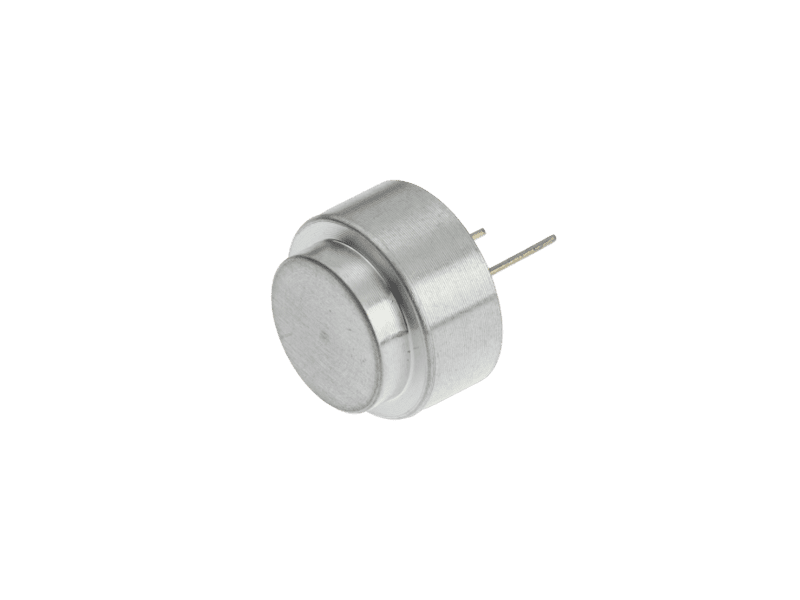
ISSRSensor 40kHz Ultrasonic Reversing Radar Transducer | High Sensitivity & Reliable Obstacle Detection
-
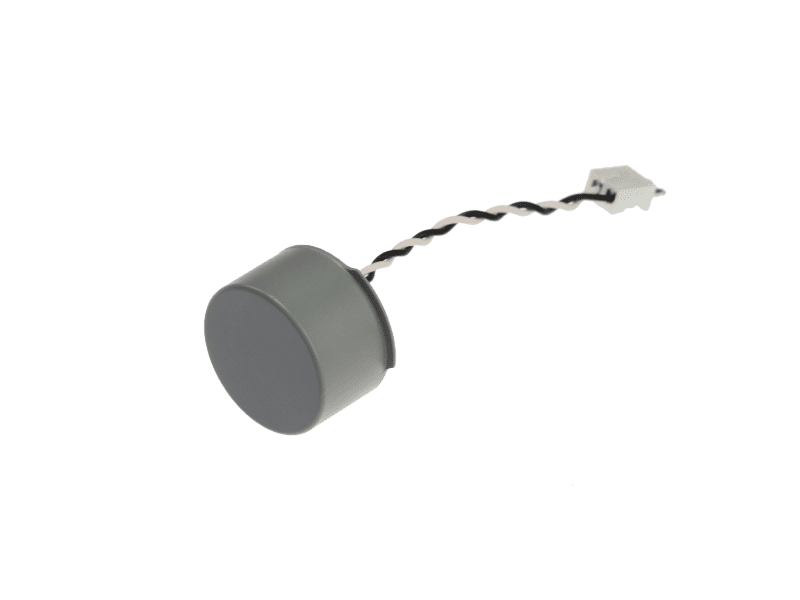
ISSRSensor 48kHz Ultrasonic Transceiver for Car Reversing Collision Avoidance – Waterproof Design
-
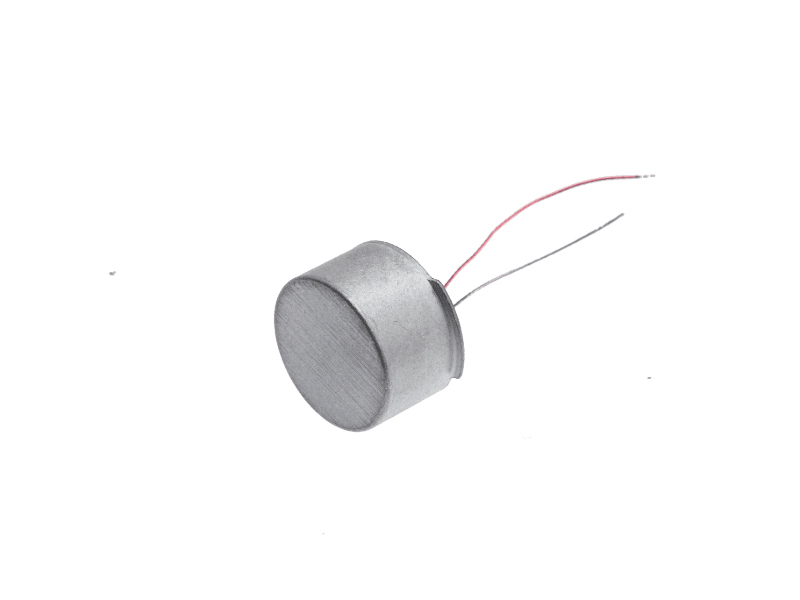
ISSRSensor Transducteur ultrasonique de 55,5 kHz pour l'évitement d'obstacles en marche arrière dans les automobiles
-

ISSRSensor 55.5kHz Waterproof Ultrasonic Transducer for Automotive Reversing Radar Systems (Transducteur ultrasonique étanche pour systèmes de radars de recul automobiles)
-
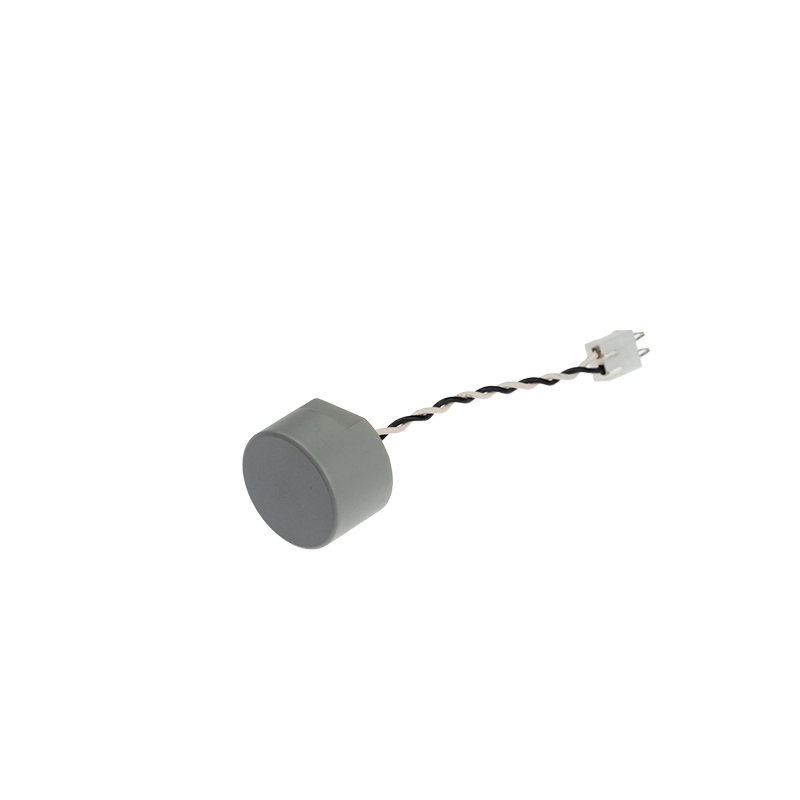
ISSRSensor 58kHz Ultrasonic Low-Frequency Ranging and Obstacle Avoidance Transducer (capteur à ultrasons basse fréquence 58kHz pour la détection et l'évitement d'obstacles)