


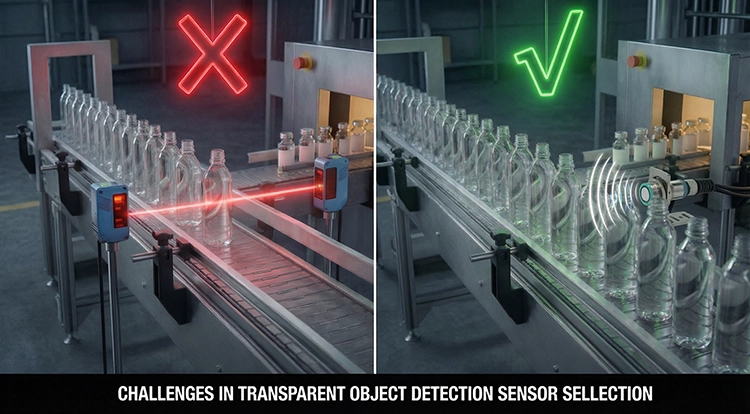
Ask any automation engineer about their biggest headache on a packaging line, and you’ll likely hear the same answer: transparent objects. Whether it’s a sleek glass vial on a pharmaceutical track or a flimsy PET water bottle speeding down a conveyor, standard photoelectric sensors often fail. The light beam simply passes straight through the clear material—a phenomenon known as “burn-through”—resulting in false readings, missed counts, and costly line jams.
When optical methods hit a wall, engineers must turn to alternative technologies. This brings us to the core of modern clear object detection sensor selection: the battle between capacitive and ultrasonic sensors. Both can see the “invisible,” but they do so using entirely different principles. Let’s break down which technology is truly the master of transparent detection.
Capacitive Sensors: Close-Quarters Detection via Dielectric Constants
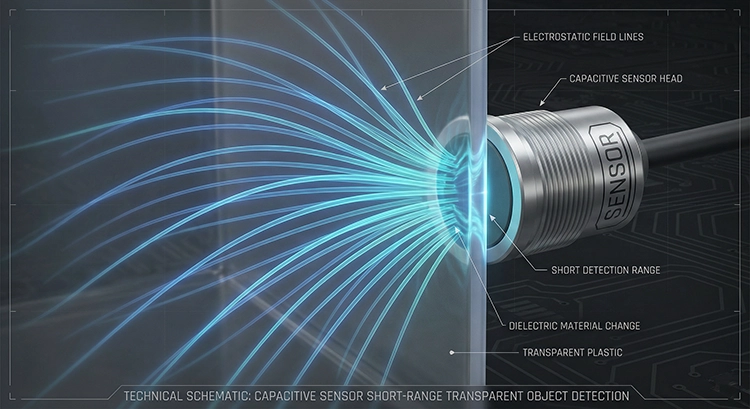
Capacitive proximity sensors do not rely on light. Instead, they generate an electrostatic field. When an object enters this field, it changes the capacitance of the oscillator circuit. The sensor detects this change in the dielectric constant of the target material, triggering the output.
Where Capacitive Shines in Clear Detection: Because they rely on dielectric properties, capacitive sensors are completely blind to color and transparency. They can easily detect clear plastics, glass, and even the liquid level inside a non-metallic, transparent container. Furthermore, their highly compact form factor makes them an excellent choice for tight machine spaces.
Limitations & Pain Points: However, the reality of factory floors exposes the vulnerabilities of capacitive sensing:
- Extremely Short Range: They are strictly near-field devices, typically maxing out at a sensing distance of just 2mm to 20mm.
- High Environmental Sensitivity: Because water has a very high dielectric constant, capacitive sensors are notoriously sensitive to humidity changes, condensation, and wet washdown environments. A rogue water droplet on the sensor face can easily trigger a false positive.
- Frequent Maintenance: If you switch your production run from a thick glass bottle to a thin plastic container, the dielectric mass changes significantly, often requiring manual retuning of the sensor’s potentiometer.
Ultrasonic Sensors: The “Acoustic Fortress” Against Transparency
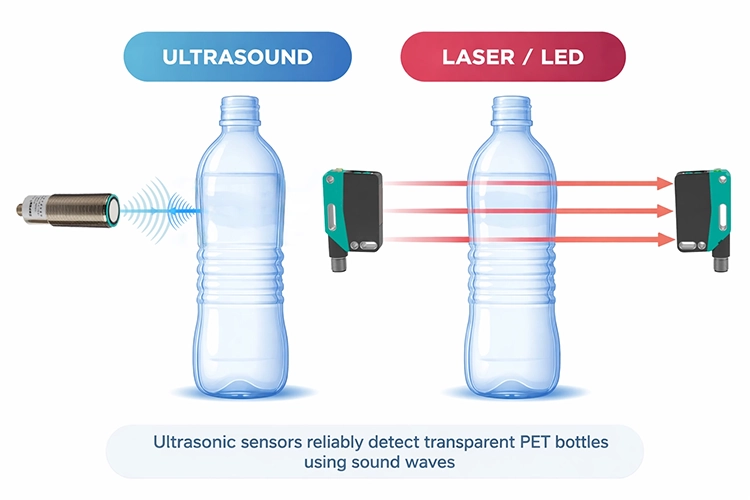
If capacitive sensors measure electrical properties, Ultraschallsensoren measure time and sound. Utilizing the sonar principle, an ultrasonic sensor emits high-frequency sound waves and calculates the Time-of-Flight (ToF) for the echo to bounce back from the target.
The Inherent Advantages for Transparent Objects: For an ultrasonic sensor, optical transparency simply does not exist.
- Material Independence: Sound waves bounce back based on a material’s acoustic impedance, not its light transmissivity. Therefore, ultrasonic sensors are natively “color-blind” and handle glass, clear films, and plastics flawlessly.
- Robustheit gegenüber der Umwelt: Factory lighting, harsh strobes, shadows, and dusty environments that cripple optical sensors have zero impact on sound waves.
- Self-Cleaning Effect: The high-frequency vibration of the ultrasonic transducer face actively shakes off light dust and condensation, making them incredibly reliable in washdown or humid environments.
Limitations to Consider:
- The Blind Zone: Ultrasonic sensors have a “dead band” right in front of the transducer where they cannot detect objects. Targets must be kept outside this minimum distance.
- Target Angulation: Highly irregular or sharply angled smooth surfaces might deflect the sound wave away from the receiver, causing a missed reading.
The Showdown: Capacitive vs Ultrasonic Sensor Comparison
| Merkmal | Capacitive Sensors | Ultraschall-Sensoren |
|---|---|---|
| Detection Principle | Electrostatic field (Dielectric constant) | Mechanical sound wave (Time-of-Flight) |
| Sensing Range | Extremely short (< 20mm) | Mid-to-Long range (up to 6m+) |
| Surface Requirements | Needs enough material mass, sensitive to flatness | Sensitive to extreme tilt angles (>15°) |
| Environmental Durability | Moderate (Highly susceptible to moisture/humidity) | Exceptional (Immune to dust, light, and minor moisture) |
| Setup & Tuning | High (Often requires manual potentiometer tweaking) | Low (Most feature simple Teach-in buttons) |
Application Scenarios: Which Should You Choose?
Scenario A: High-Speed Transparent Bottle Detection
- The Pain Point: Clear bottles stacked tightly together on a fast-moving conveyor.
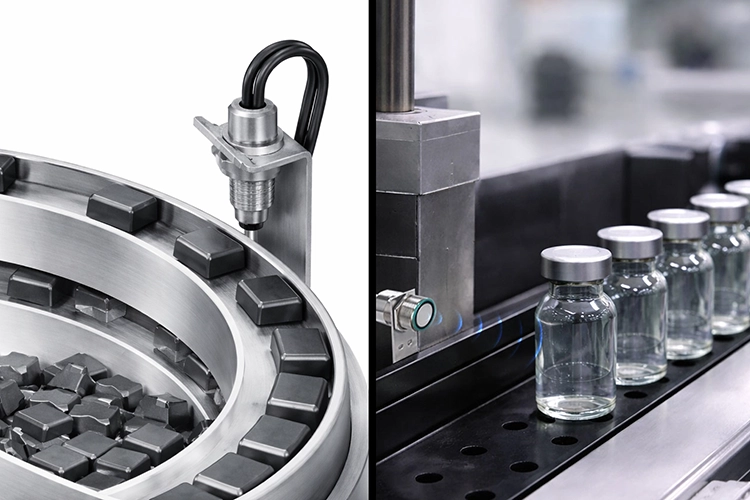
- The Verdict: Ultrasonic. By targeting the bottleneck or using an analog output to map the “valleys” between bottles, ultrasonic technology provides flawless counting. It is the undisputed champion for transparent bottle detection.
Scenario B: Micro-Plastic Parts in a Feeder Bowl
- The Pain Point: Tiny, clear plastic components moving along a very narrow, space-constrained track.
- The Verdict: Capacitive. The ultra-short range and miniature housing options make capacitive sensors ideal for confirming the presence of tiny clear objects where an ultrasonic sensor’s blind zone would be an issue.
Scenario C: Liquid Level Control in Clear Tubes
- The Verdict: It depends. If you need to detect the liquid through the wall of a small clear tube, a bypass capacitive sensor is excellent. If you are measuring the level from the top down without contacting the liquid, a downward-facing ultrasonic sensor is superior.
Scenario D: Clear Film Web Guiding and Tension Control
- The Pain Point: Monitoring the edge or roll diameter of transparent packaging film.
- The Verdict: Ultrasonic. Sound waves reliably bounce off the roll to monitor diameter, completely unaffected by the film’s transparency, color changes, or layered thickness. (Note: ISSR Sensor specializes in highly accurate ultrasonic web guiding solutions).
Engineer’s Best Practices for Installation
To guarantee maximum uptime, how you install the sensor is just as important as the technology itself.
For Ultrasonic Sensors:
- Manage the Blind Zone: If space is tight, mount the sensor slightly recessed or use a 45-degree acoustic deflector to artificially increase the sound path distance.
- Master the Angles: For round targets like a clear PET bottle sensor application, a slight mounting tilt of 10-15 degrees can help minimize unwanted background reflections.
- Eliminate Crosstalk: If mounting multiple ultrasonic sensors side-by-side, ensure they are synchronized or multiplexed via their control wires to prevent their sound waves from confusing each other.
For Capacitive Sensors:
- Ensure the sensing face remains absolutely clean. Any accumulation of moisture or sticky residue will drastically alter the dielectric reading and cause false triggers.
The Final Verdict: The Best Solution for Clear Objects
When comparing a capacitive vs ultrasonic sensor, the choice comes down to range and environment. If you are detecting small objects at point-blank range in a perfectly clean, climate-controlled environment, a capacitive sensor is a cost-effective choice.
However, for the vast majority of modern packaging, food and beverage, and pharmaceutical lines, Ultraschallsensoren deliver a significantly higher Return on Investment (ROI). Their total immunity to optical transparency, longer detection ranges, and rugged resistance to factory floor contamination make them the ultimate solution for glass vial counting and transparent object detection.
FAQ
Q1: Can ultrasonic sensors detect clear plastic film?
A1: Absolutely. Sound waves reflect off the acoustic impedance of the film, completely ignoring its optical transparency. This makes them perfect for clear web guiding and roll diameter measurements.
Q2: Why does my capacitive sensor trigger falsely in a humid environment?
A2: Capacitive sensors measure dielectric constants. Water has a very high dielectric constant (around 80), while most plastics are around 2 to 3. Even minor condensation on the sensor face can mimic a large target, causing false triggers.
Q3: Are photoelectric sensors with polarization filters better than ultrasonic sensors?
A3: Polarized retro-reflective sensors are a step up from standard optical beams for clear objects, but they still struggle with smudged glass, highly faceted bottles, or heavy dust. Ultrasonic sensors bypass optical issues entirely, offering a more robust long-term solution.
Q4: How do I solve the blind zone issue on an ultrasonic sensor?
A4: If you cannot move the sensor further back, you can use a soundpipe or a 90-degree deflector block to extend the path of the sound wave without taking up more physical depth on your machine frame.
-
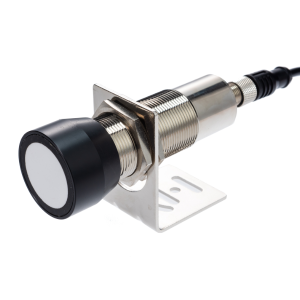
ISSR 4M All-in-One-Ultraschall-Füllstandssensor Schalter/Analog-/Digitalausgang
-
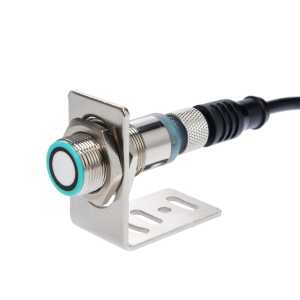
ISSR 500mm Hochpräzisions-Ultraschall-Abstandssensor mit kurzer Reichweite|200kHz
-
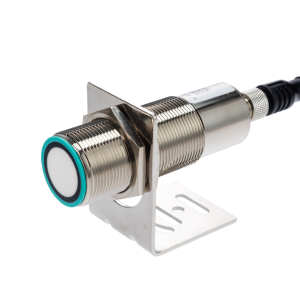
ISSR All-in-One 500MM Ultraschallsensor: Schalter, Analog- und Datenausgang
-
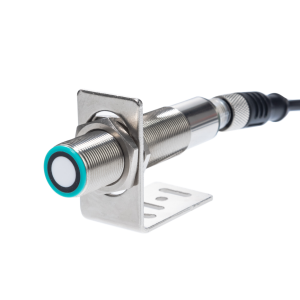
ISSR All-in-One-Ultraschallsensor: 1m Reichweite Füllstand & Objekterkennung
-
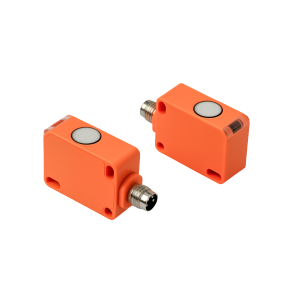
ISSR F77-Ultraschall-Näherungsschalter
-
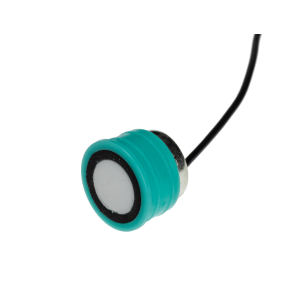
ISSR 200kHz hochempfindlicher Ultraschallwandler-Sensor für Doppelbogen- und Abstandserkennung