










I. The Evolution of Industrial Perception
In the transition from mechanized production to intelligent Industry 4.0, the demands placed on sensor technology have shifted fundamentally. While optical (photoelectric) and inductive sensors remain the workhorses of standard detection, they encounter a hard “Physics Wall” when environmental conditions degrade or material properties fluctuate.
Modern manufacturing lines—handling transparent glass, light-absorbing carbon fiber, or operating amidst steam and dust—require a sensing modality that is independent of visual characteristics. Ultrasonic Technology fills this critical gap. Unlike optical sensors that rely on light intensity, ultrasonic technology utilizes Time-of-Flight (ToF) physics. This makes the detection purely geometric and texture-independent, allowing for robust performance on “difficult” targets like clear glass, dark rubber, or variable-color packaging where optical sensors often fail.
II. Engineering Fundamentals: Beyond Time-of-Flight
To deploy ultrasonic sensorseffectively, engineers must move beyond the simplified definition of “distance measurement.” Advanced application relies on leveraging three distinct physical interaction modes of sound waves.
2.1 The Three Dimensions of Acoustic Sensing
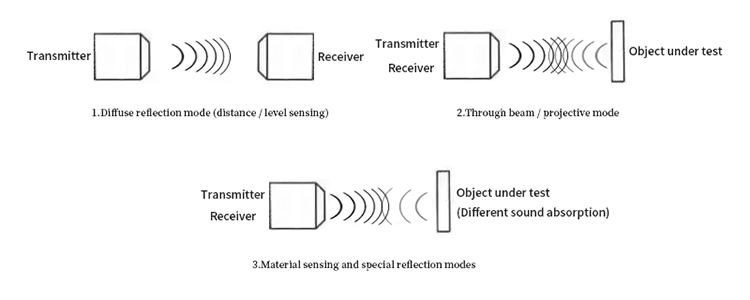
2.1.1 Transmissive Mode (Attenuation & Blockage):
- Mechanism: Used in Through-Beam configurations (separate Emitter and Receiver). The sensor does not measure distance; it measures the loss of energy.
- Physics: When an object (or a second sheet of material) blocks the path, the signal amplitude drops. This allows for the detection of internal structural changes (like air gaps in double sheets) or linear edge masking, completely independent of surface color or reflectivity.
2.1.2 Reflective Mode (Time-of-Flight-ToF):
- Mechanism: The sensor emits a pulse and calculates distance (d ) based on the return time (t ) and speed of sound (c ).
- Physics: Relies on the target having a sufficient Acoustic Impedance Mismatch with the air to reflect energy back to the source. This is the standard mode for ranging and presence detection.
2.1.3 Absorptive Mode (Material Analysis):
- Mechanism: A sophisticated use of Signal Amplitude Evaluation.
- Physics: Different materials absorb sound energy at different rates. A hard surface (Steel) reflects ~99% of energy, a porous surface (Foam, Wool) absorbs energy. By analyzing the strength of the echo—not just its timing—sensors can distinguish between materials (e.g., confirming a soft foam insert is present inside a hard plastic shell) even if they are at the exact same distance.
2.2 Critical Installation Constraints
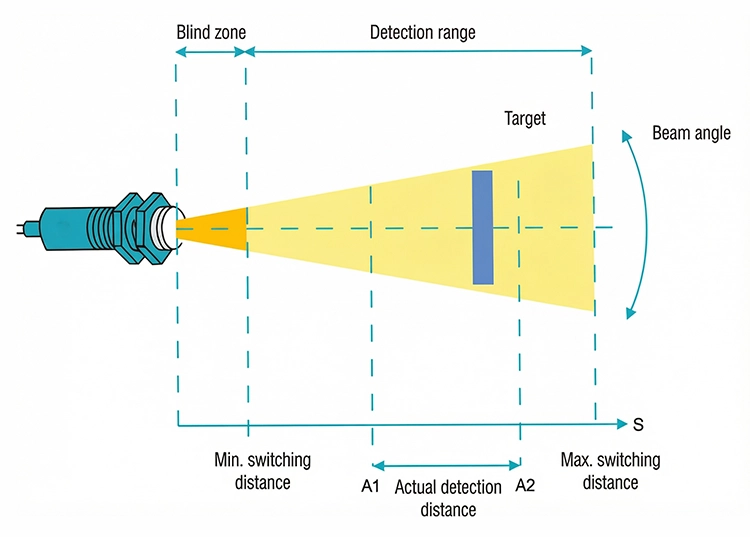
Successful integration requires respecting the inherent limitations of piezoelectric transducers:
-
The Blind Zone (Dead Band):
The transducer acts as both speaker and microphone. After emitting a high-energy pulse, the ceramic element mechanically vibrates (“rings”) for a few milliseconds. During this Ringing Time, the sensor is “deaf” to returning echoes.- Engineering Rule: Mechanical designs must include mounting stand-offs to ensure the target never enters this zone (typically 0–100mm). If a target breaches the blind zone, the output becomes indeterminate and unreliable.
-
Beam Geometry (The Sound Cone):
Sound propagates in a volumetric cone (typically 6° to 12°), not a laser-like line.- Engineering Rule: The detection zone is volumetric. Any machine rails, brackets, or tank walls protruding into this cone will generate False Echoes. Installations require a clear path calculation based on the beam angle and target distance.
III. Deep Dive: Core Application Scenarios
Scenario 1: Complex Object Detection (Transparency & Black Targets)
The Challenge:
High-speed packaging lines often handle materials that fool optical sensors: clear glass bottles (transparency) or black plastic trays (light absorption).
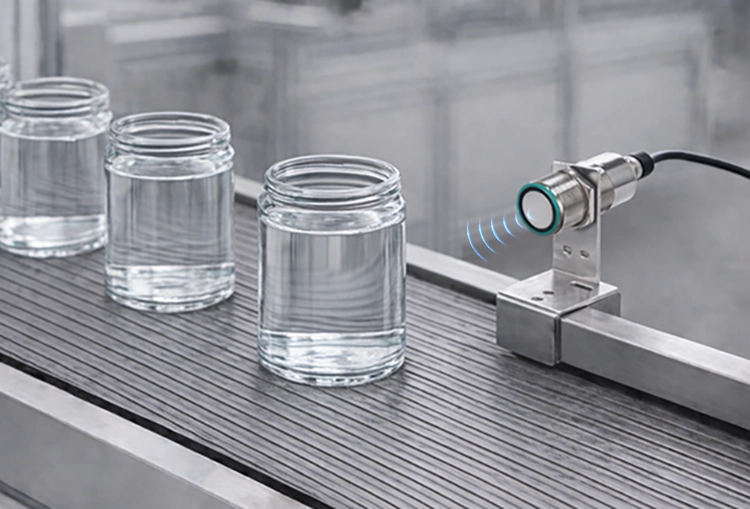
The Physics of Failure (Optics):
- Photoelectric sensors look through clear objects.
- Black rubber or plastic absorbs light, preventing the return signal required for diffuse optical sensors.
The Ultrasonic Solution:
- Impedance Detection: The sensor detects the massive difference in Acoustic Impedance (Z) between Air (Zair ≈ 400) and the Solid Object (Zsolid > 106). Whether the object is clear glass or black rubber, the sound wave bounces off the boundary effectively.
-
Retro-reflective Configuration: For irregular shapes (e.g., curved shampoo bottles) that might scatter sound away from the receiver, a Retro-reflective Mode is recommended.
- Setup: The sensor is taught to recognize a fixed background (e.g., a metal rail).
- Logic: Any object passing between the sensor and the rail interrupts the signal or changes the time-of-flight. This provides a binary, fail-safe detection regardless of the object’s angle or shape.
Scenario 2: Roll Diameter and Tension Control
The Challenge:
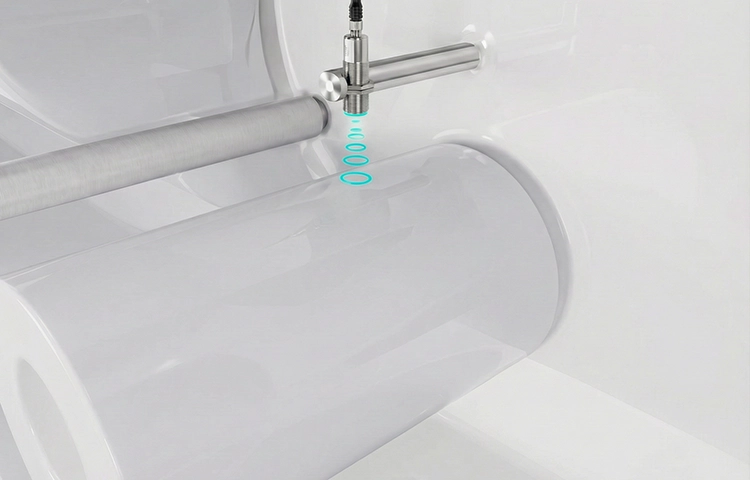
The Physics of Specular Reflection:
Engineering Optimization:
- The 90° Rule: The sensor must be aligned strictly perpendicular (90°) to the roll axis. A deviation of just 3° on a smooth foil roll will cause the sound pulse to deflect entirely away from the receiver, resulting in signal loss.
- Analog Integration: Utilizing sensors with 0–10V or 4–20mA analog output allows the PLC to calculate the Roll Inertia (I = m·r2) continuously. This enables dynamic PID tuning, preventing web tears during rapid acceleration or deceleration.
Scenario 3: Transmission Mode Applications (Double Sheet & Web Guiding)
This category utilizes the Transmissive Mode, ignoring distance to focus on energy attenuation.
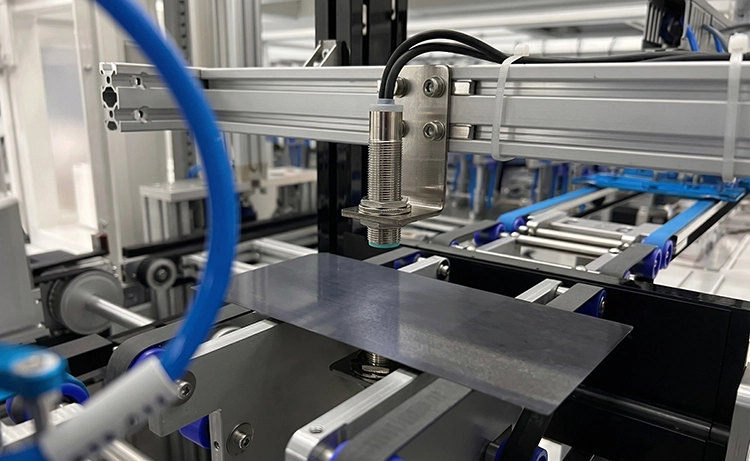
A. Double Sheet Detection (The Impedance Barrier)
- The Context: Preventing two sheets (metal, paper, wafer) from feeding simultaneously into a press, which could damage tooling.
- Why Capacitive Fails: Capacitive sensors rely on dielectric constants. If paper moisture changes or metal alloy varies, they require constant recalibration.
- The Ultrasonic Physics:
- Single Sheet: The sound wave hits the sheet, induces vibration, and transmits through to the receiver.
- Double Sheet: A microscopic layer of air is always trapped between two overlapping sheets.
- The Mechanism: The thin air gap between two sheets creates a massive Acoustic Impedance Mismatch. This physical phenomenon causes nearly 100% of the ultrasonic energy to reflect or dissipate, preventing transmission to the receiver. A near-zero signal amplitude acts as the deterministic trigger for identifying a double-sheet fault.
- Result: The receiver sees a near-zero signal. This detection is purely mechanical and works independently of the sheet’s color, print, or magnetism.
B. Web Edge Guiding (Fork Sensors)
- The Context: Aligning transparent films or open-mesh fabrics during winding.
- The Linear Physics: An ultrasonic fork sensor measures the percentage of blockage.
- If the web covers 50% of the acoustic beam, the output signal drops by exactly 50%.
- Mesh Advantage: Unlike optical sensors that “jitter” when seeing through holes in a mesh, the wide sound beam integrates the average mass of the material, providing a stable, linear control signal for the edge position.
Scenario 4: Liquid Level Monitoring in Corrosive Chemical Tanks
The Challenge: Aggressive Media Environments
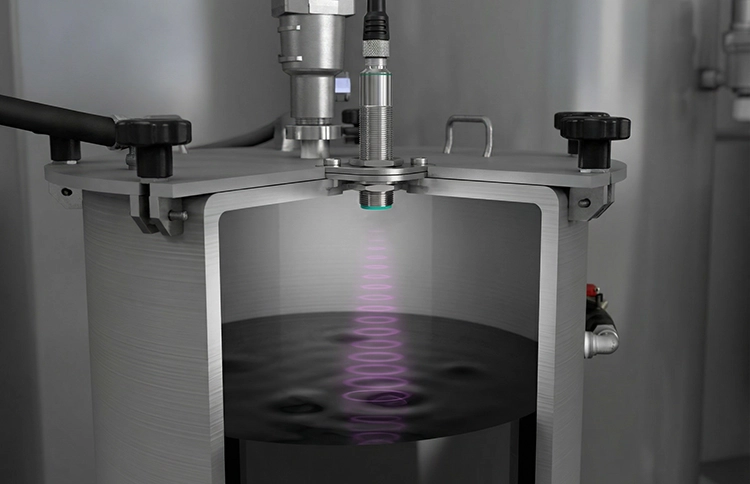
In the chemical industry, storage tanks often contain strong acids, alkalis, or other highly corrosive liquids. Traditional level measurement technologies face severe limitations:
- Contact Risks: Contact-based devices (such as submersible pressure transmitters, float switches, or capacitance probes) must physically touch the liquid to function.
- High Material Costs: To resist corrosion, contact sensors often require expensive exotic alloys (e.g., Hastelloy, Tantalum) or special coatings. Even with these materials, long-term immersion often leads to sensor degradation, drift, or seal leakage.
The Engineering Solution: Ultrasonic Non-Contact Measurement
For these applications, Ultrasonic Sensors provide the ideal solution. Their operating principle offers unique advantages in corrosive environments.
Key Advantages
-
True Non-Contact Operation:
- The sensor is mounted at the top of the tank and uses the air gap as the transmission medium to measure the distance to the liquid surface.
- Benefit: This “Zero Contact” design ensures the sensor body remains physically isolated from the corrosive liquid, completely eliminating the risk of chemical erosion on sensitive components.
-
Material Durability against Vapors:
- Modern industrial ultrasonic transducers are typically encapsulated in PVDF (Polyvinylidene Fluoride).
- Benefit: Even in tanks filled with corrosive vapors or fumes, PVDF provides exceptional chemical resistance, ensuring the sensor remains stable and durable in acidic or alkaline atmospheres.
-
Maintenance & Safety:
- Because the sensor is not inserted into the liquid, installation and maintenance do not require emptying the tank. This significantly reduces operational downtime and minimizes personnel exposure to hazardous chemicals.
The Challenge:
Mobile robots need redundant safety systems. LiDAR is excellent for mapping but has blind spots.
- LiDAR Weaknesses: Transparent Glass (transmission), Mirrors (deflection), Black Objects (absorption), and Mesh Fences (beam passes through gaps).
Ultrasonic Optimization:
- Volumetric Shield & Safety Compliance: The wide sound cone detects the “solid mass” of mesh fences and glass walls that narrow lasers miss. This detection strategy aligns with ISO 3691-4 standards for industrial mobile robots, providing a certified redundancy layer for personnel safety independent of the primary navigation system.
-
Crosstalk Mitigation: When mounting an array of sensors on a bumper, acoustic interference is a major risk.
- Protocol: Connect the Synchronization Pins (Sync) of all sensors in the array. This forces them to fire and listen simultaneously, effectively treating the array as a single “sonar skin” and preventing Sensor A from picking up Sensor B’s echo.
IV. Installation & Selection Guide: Handling Environmental Variables
To ensure the reliability of the applications described above, engineers must account for environmental factors that alter the physics of sound. Ignoring these variables can lead to measurement drift or signal loss.
4.1 Managing Temperature Drift (Precision Control)
Since the speed of sound changes with temperature (increasing by ≈ 0.6 m/s per 1°C rise), a simple 10°C shift in ambient temperature can cause a 1.7% measurement error if left uncompensated.
- For General Environments: Always select sensors with Internal Temperature Compensation (built-in NTC thermistors) to automatically adjust for daily fluctuation.
- For Gradient Environments: In scenarios where the sensor body temperature differs from the target area (e.g., a sensor mounted on a cold bracket measuring a hot liquid tank), internal compensation is insufficient. An External Temperature Probe must be installed directly in the measurement zone to provide an accurate reference.
4.2 Penetrating Steam and Vapor (Signal Integrity)
In chemical tanks or food processing lines (as seen in Section III), heavy steam changes air density and absorbs acoustic energy, causing high-frequency signals to “disappear” before returning.
- Selection Rule: Avoid standard 200 kHz sensors in steamy conditions.
- Recommendation: Specify Low-Frequency Sensors (40–80 kHz). Their longer wavelengths offer superior penetration power through vapor and foam, ensuring a stable echo return even in high-humidity environments.
V. Future Application Prospects: The Era of Intelligent Sensing
As Industry 4.0 matures, the role of ultrasonic sensors is undergoing a fundamental paradigm shift. They are evolving from passive “switches” (Outputting 0 or 1) into active Intelligent Data Nodes that communicate rich process information.
5.1 Digitalization and IO-Link Integration
The traditional tuning method—using a screwdriver to turn a potentiometer on the sensor back—is becoming obsolete. The integration of IO-Link communication protocols transforms the sensor’s utility:
- Dynamic Parameterization: In a flexible production line, a machine might handle a small box (Product A) followed by a large crate (Product B). Through IO-Link, the PLC can instantly re-write the sensor’s “Switching Window” parameters on the fly, eliminating downtime for mechanical adjustments.
- Beam Shaping: Advanced sensors now allow software-defined beam widths. An engineer can narrow the beam to penetrate a deep tank or widen it to detect wire mesh, all configured remotely via the HMI.
5.2 Predictive Maintenance (Condition Monitoring)
Ultrasonic sensors are uniquely positioned to self-diagnose environmental health before a failure occurs.
- The “Signal Strength” Metric: Intelligent sensors continuously report the “Echo Amplitude” or “Excess Gain” value.
- The Scenario: In a dusty cement plant, dust slowly accumulates on the sensor face.
- Old Way: The sensor fails suddenly when the dust blocks the signal completely. Machine stops.
- New Way: The PLC monitors the signal margin. If the amplitude drops from 100% to 70% over a week, the system triggers a “Maintenance Alert: Clean Sensor 3” before the signal is lost. This is true Predictive Maintenance.
5.3 Advanced Signal Processing (Noise Suppression)
Modern sensors are incorporating stronger onboard processors (Edge Computing) to handle complex acoustic environments.
- Interference Suppression: Algorithms can now “learn” the acoustic signature of a tank’s internal agitator blade. The sensor maps this periodic interference and subtracts it from the signal, allowing it to track the liquid level continuously even when the agitator passes directly through the sound beam.
- Multi-Echo Analysis: Instead of just reacting to the first echo, smart sensors can evaluate multiple return signals to distinguish between a close-range rain droplet (noise) and the actual liquid surface (target) further down, significantly reducing false alarms in outdoor applications.
5.4 Miniaturization for Robotics
With the rise of collaborative robots (Cobots) and drone logistics, size and weight are critical.
- MEMS Ultrasound: The development of Micro-Electro-Mechanical Systems (MEMS) based ultrasonic transducers is shrinking the footprint to chip-scale. This allows for high-density arrays to be embedded into robot fingertips for “near-field” tactile sensing, or into drone skins for 360-degree collision avoidance without the weight penalty of traditional ceramic transducers.
Ⅵ. Summary
Ultrasonic sensors are sophisticated instruments that interact with the mechanical, structural, and surface properties of the target. By moving beyond simple Time-of-Flight and utilizing Transmission Attenuation (for double sheets/webs) and Absorption Analysis (for material identification), engineers can solve detection problems that appear impossible for optical systems. The key to success lies in the engineering details: respecting the Blind Zone, sizing the Stilling Well, and compensating for Thermodynamics.
FAQ
Q1: Can ultrasonic sensors distinguish between a hard plastic cap and a missing cap (soft foam liner)?
A1: Yes. This utilizes the Absorption Mode. Configure the sensor (via IO-Link) to monitor Echo Amplitude. A hard cap will return a strong signal (e.g., >80%), while the exposed foam liner will absorb sound and return a weak signal (e.g., <20%), even if the distance measurement is identical.
Q2: Why does my sensor reading fluctuate in a narrow tank?
A2: You are likely experiencing Side Lobe Interference. The sound cone is hitting the tank walls or internal welds.
- Fix: Use a Stilling Well (as described in Scenario 4) or switch to a sensor with a narrower beam angle. Do not try to “filter out” wall reflections purely with software; the physics must be corrected first.
Q3: My sensor works on the conveyor but fails when the belt is empty. Why?
A3: If the conveyor belt is smooth or has a seam, it might be reflecting the sound away (specular reflection) or creating noise.
- Fix: Angle the sensor slightly (5° – 10°) away from perpendicular relative to the belt surface. This ensures the echo from the empty belt is deflected away (reading “Infinite/No Object”), while the taller product will still reflect sound back to the sensor.
-
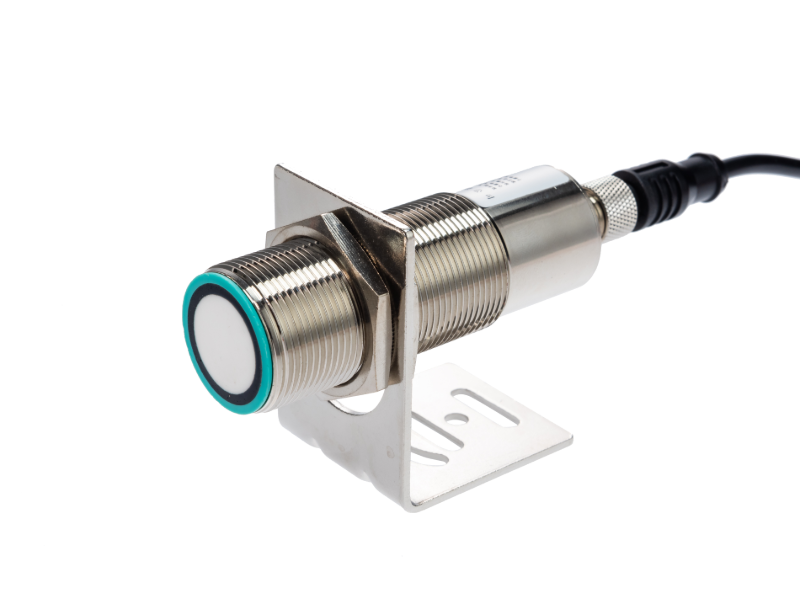
ISSRSensor All-in-One 500MM Ultrasonic Sensor: Switch, Analog & Data Output
-
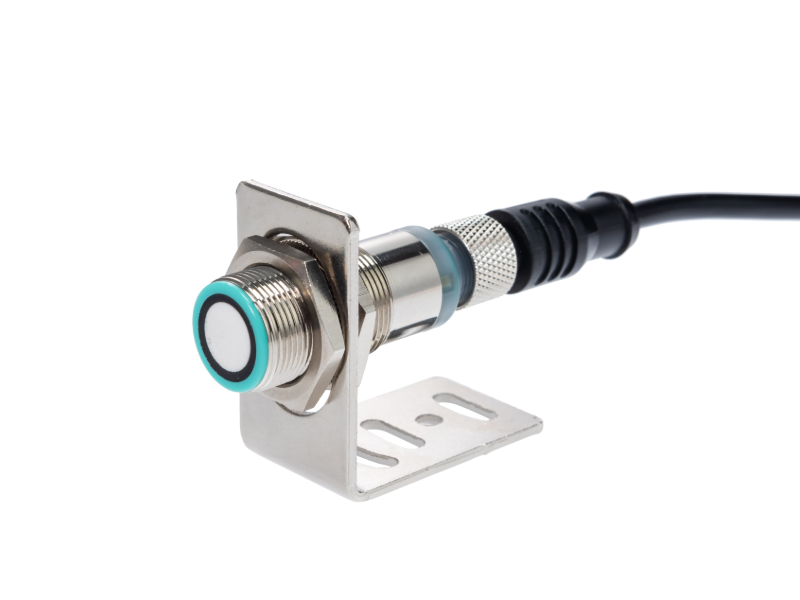
ISSRSensor 0.15M 400kHz Ultra-high Precision Short-Form Ultrasonic Distance Sensor
-
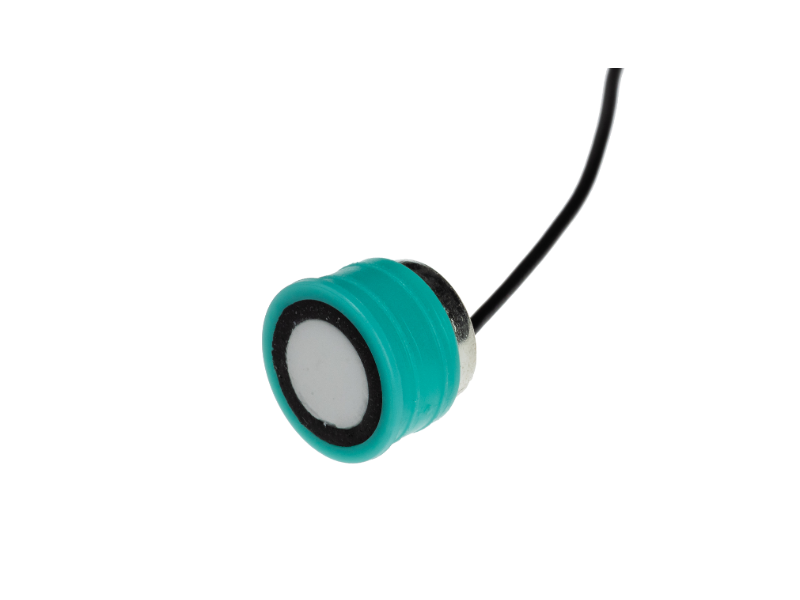
ISSRSensor 200kHz High-Sensitivity Ultrasonic Transducer Sensor for Double Sheet & Distance Detection
-
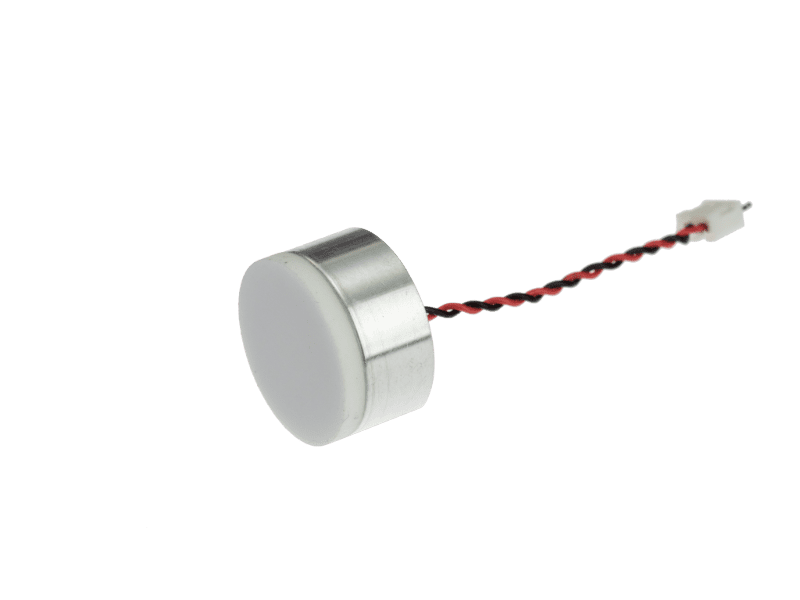
ISSRSensor 200kHz Ultrasonic Transducer Probe for Distance Measurement and Edge Correction
-
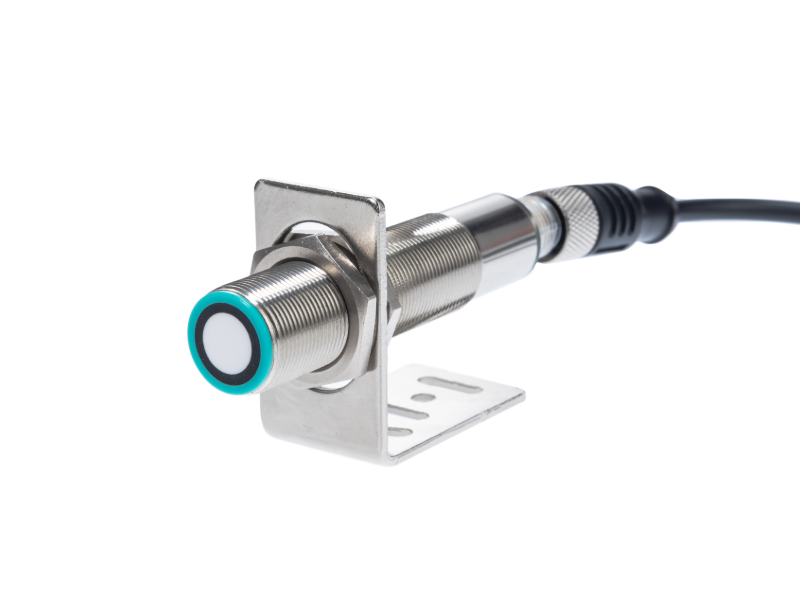
ISSRSensor All-in-One Ultrasonic Sensor: 1m Range Level & Object Detect
-
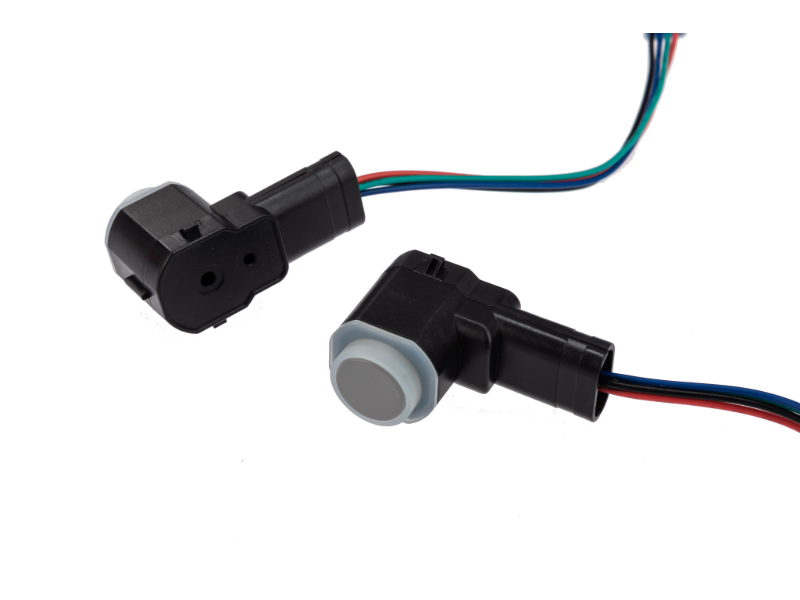
ISSRSensor 1M 58kHz Ultrasonic AGV Obstacle Avoidance Sensor
-
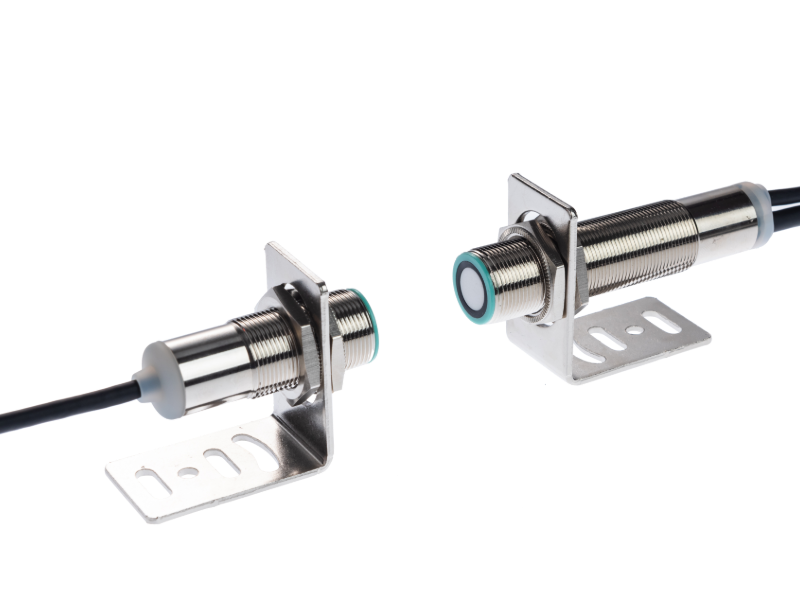
ISSRSensor Ultrasonic Double Sheet Sensor | Multi-Material Detection for Automation
-
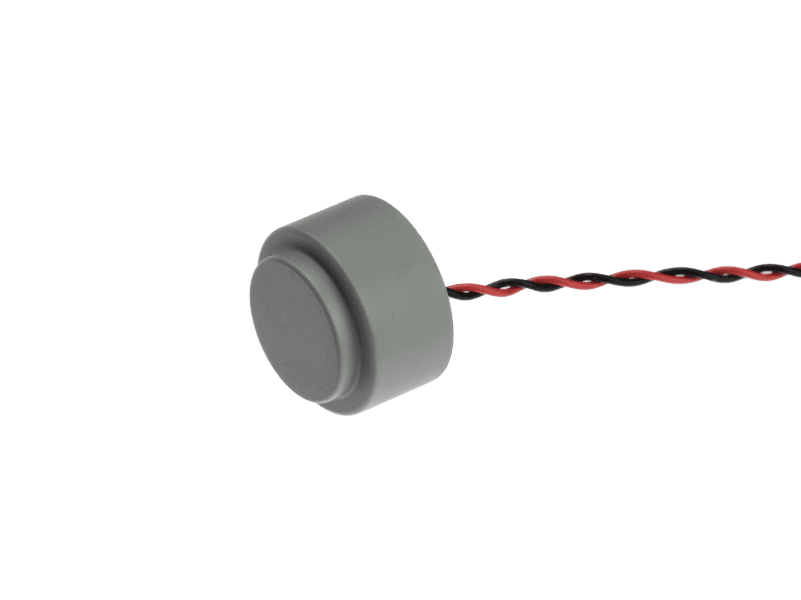
ISSRSensor 40kHz High-Sensitivity Ultrasonic Ranging and Obstacle Avoidance Transducer