









O manuseamento automatizado de materiais exige cada vez mais uma maior densidade da frota e velocidades mais elevadas dos veículos. Como os veículos guiados automaticamente (AGVs) e Robôs Móveis Autónomos (AMRs) evoluem para máquinas altamente complexas, que se deslocam dinamicamente por corredores estreitos, a sua arquitetura de segurança deve evoluir em paralelo.
Durante anos, a indústria da robótica tem-se apoiado fortemente em scanners LiDAR 2D para localização e mapeamento simultâneos (SLAM) e a segurança do perímetro. No entanto, a dependência de um único plano ótico para evitar colisões é uma vulnerabilidade de engenharia reconhecida. A tecnologia LiDAR é limitada pela física ótica. Tem dificuldade em lidar com superfícies altamente especulares (reflectoras), divisórias de vidro transparentes e - o que é mais crítico - obstáculos que se situam abaixo do seu plano de varrimento 2D localizado, tais como paletes de madeira ou dentes de empilhadora salientes.
É aqui que Sensores ultra-sónicos colmatar a lacuna. Servindo como uma camada de deteção de campo próximo sem contacto para robôs móveis, a tecnologia acústica é imune a ilusões ópticas, interferência da luz ambiente e transparência do material. No entanto, especificar o sensor ultrassónico correto não é tão simples como marcar uma caixa.
A escolha do hardware correto requer um conhecimento profundo da física acústica, da arquitetura do transdutor e da latência dos dados. Se está a arquitetar um AGV moderno, aqui está o guia de engenharia definitivo para avaliar e selecionar o melhor sensor ultrassónico de desvio de obstáculos, comparando as duas arquitecturas dominantes da indústria: Integrado versus Transcetor dividido módulos.

1. Noções básicas de deteção acústica e a zona cega
Antes de avaliar as folhas de dados, é crucial compreender como os sensores ultra-sónicos medem a distância e porque possuem limitações físicas inerentes.
Os sensores ultra-sónicos funcionam segundo o princípio do tempo de voo (ToF). Um transdutor piezoelétrico emite uma explosão de ondas sonoras de alta frequência (por exemplo, 58 kHz). Estas ondas viajam pelo ar, atingem um objeto e reflectem-se de volta. A distância é calculada utilizando a fórmula da linha de base:
d = (v · t) / 2
Onde d é a distância, t é o tempo de voo medido (da emissão à receção do eco), e v é a velocidade do som, que varia com a temperatura e a humidade do meio de propagação.
O problema da deterioração do zumbido
Quando um sensor integrado (em que uma única sonda funciona como altifalante e microfone) dispara um impulso acústico, o cristal piezoelétrico vibra fisicamente. Quando o sinal elétrico pára, o cristal continua a ressoar devido à inércia mecânica - um fenómeno conhecido como “decaimento do toque”.”
Durante este período de decaimento, o sensor não pode “escutar” os ecos de retorno porque a sua própria vibração interna sobrepõe-se a quaisquer sinais acústicos de entrada.
Este silêncio necessário cria uma zona cega (também chamada de zona morta) imediatamente em frente ao sensor. Se um AGV depende de um sensor com um 25 cm zona cega, o robô é completamente cego para os objectos imediatamente antes do impacto físico.
Como escolher: Arquitetura de Transcetor Integrado vs. Dividido
Para atenuar esta situação, os fabricantes adoptam normalmente uma de duas arquitecturas de hardware distintas, dependendo das necessidades operacionais:
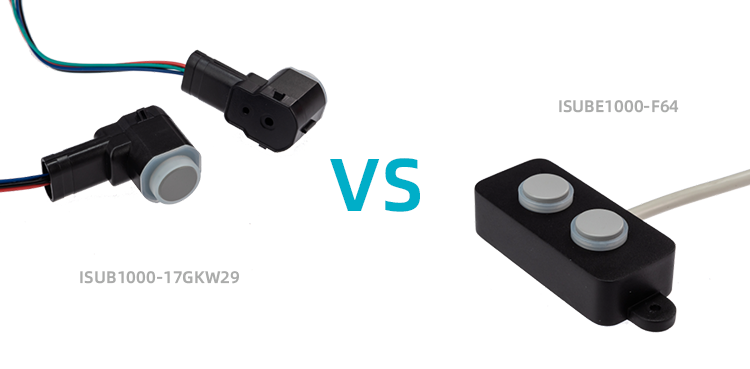
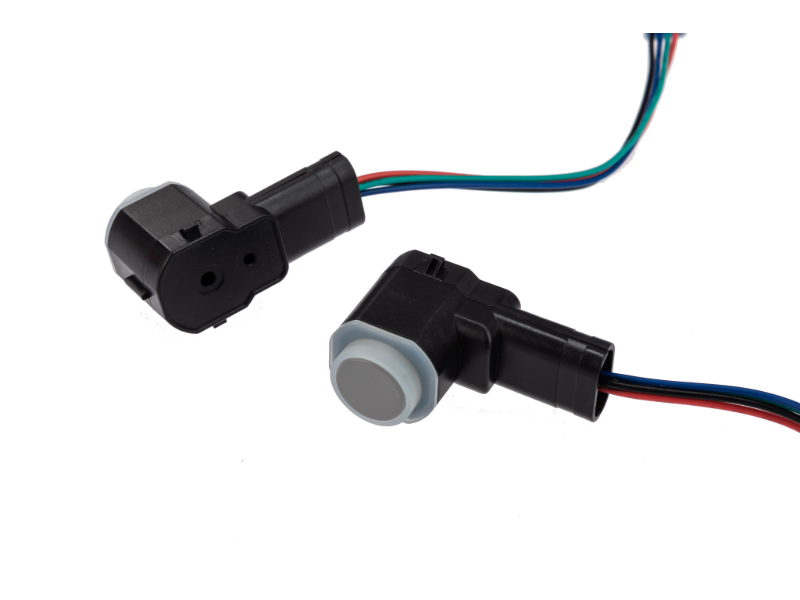
Arquitetura integrada: (por exemplo, ISSR ISUB1000-17GKW29 Série): Este design aloja tanto o transmissor como o recetor numa única sonda IP67 compacta, altamente sintonizada. Através de materiais de amortecimento internos avançados e 58 kHz frequências, os sensores integrados de alta qualidade podem suprimir o decaimento do zumbido com rapidez suficiente para atingir um valor altamente respeitável de ≤ 10 cm zona cega, mantendo um máximo de 100 cm gama. Esta é a escolha ideal para a limpeza de vias frontais para fins gerais, onde a compactação e a facilidade de cablagem são fundamentais.
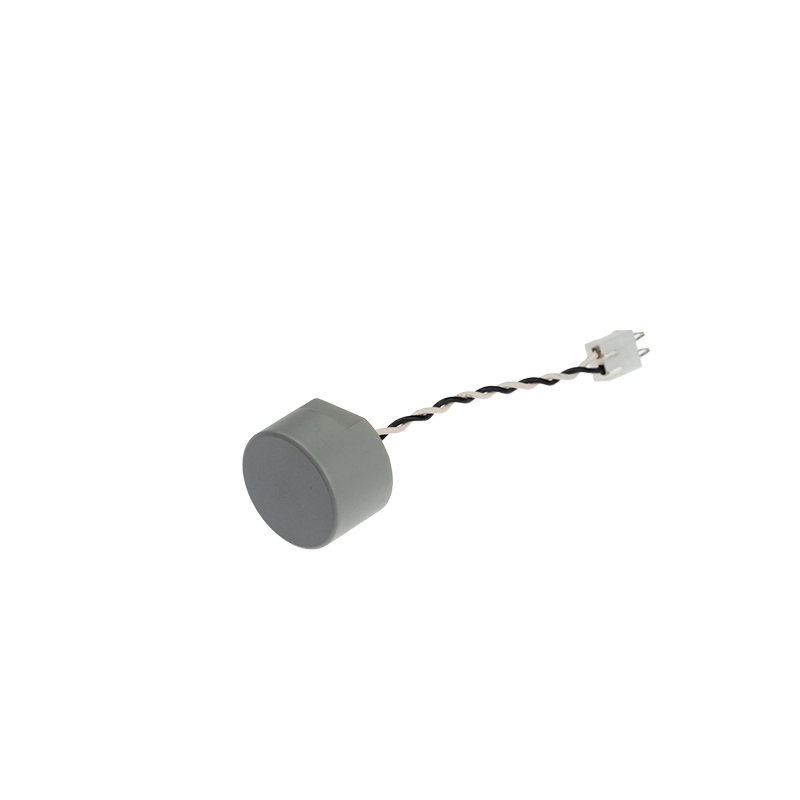
Arquitetura do transmissor dividido: (por exemplo, ISSR ISUBE1000-F64 Série): Quando um AGV requer uma acoplagem de alta precisão em distâncias muito curtas ou navega em ambientes ultra-densos, um 10 cm O ângulo morto é ainda demasiado grande. A arquitetura do transmissor dividido separa completamente a sonda do transmissor (TX) e a sonda do recetor (RX). Uma vez que a sonda RX nunca vibra fisicamente devido à transmissão do impulso de saída, está imediatamente pronta para ouvir ecos. Esta mudança arquitetónica reduz radicalmente a zona cega para um nível ultra baixo de ≤ 3 cm. Se o seu robô necessitar de uma distância mínima de deteção extremamente curta, é normalmente preferível um design de transmissor dividido.

2. Geometria de propagação do feixe e interferência do pavimento
A energia acústica não viaja numa linha laser reta; propaga-se para fora num lóbulo cónico 3D. O ângulo deste cone acústico determina o campo de visão do robot (FOV).
Um feixe largo simétrico padrão (e.g., um cone de 60°) fornece uma excelente cobertura volumétrica. No entanto, se for montado demasiado baixo num chassis de um AGV, a metade inferior da onda acústica atingirá o chão do armazém, fazendo ricochete e inundando o microcontrolador com leituras de distância falsas positivas (obstáculos fantasma).
Ao selecionar um sensor, deve fazer corresponder a geometria do feixe ao seu local de montagem:
A vantagem do ângulo duplo assimétrico
Instalações do para-choques principal virado para a frente
Para instalações no para-choques principal virado para a frente, o ISSR ISUB1000-17GKW29 utiliza uma buzina acústica avançada, moldada assimetricamente, que molda a onda de propagação a 75° horizontalmente (Eixo X) e 45° na vertical (Eixo Y).
- O 75° Eixo X fornece uma enorme varredura de segurança horizontal, permitindo que um único sensor cubra a largura de um AGV compacto.
- O 45° Eixo Y restringe deliberadamente a propagação vertical, assegurando que o lóbulo acústico se mantém paralelo ao chão, reduzindo significativamente a interferência do ressalto do chão, ao mesmo tempo que capta paletes de baixo perfil.
A matriz de precisão simétrica
Para monitorização localizada - como ângulos mortos traseiros, espaço lateral apertado ou conjuntos de sensores multiponto - um feixe simétrico é altamente eficaz. A série de sondas divididas ISSR ISUBE1000-F64 emite um feixe simétrico de 60° controlado nos eixos X e Y. Ao montar estrategicamente estas sondas ao longo do chassis, os engenheiros podem sobrepor os cones de 60° para criar um anel de segurança multi-nodal de alta resolução à volta do veículo.

3. Latência do sistema e o limiar de 10 milissegundos
No domínio da prevenção de colisões robóticas, a latência dos dados é diretamente proporcional ao perigo físico. Exemplo: se o circuito de controlo cinemático demorar 100 ms para receber uma atualização do sensor, um AGV que se desloque a 1,5 m/s terá atravessado 0.15 m entre quadros de dados.
Os sensores ultra-sónicos padrão da indústria automóvel possuem frequentemente ciclos de polling de 50 ms para 100 ms. Para a robótica industrial, isto é inaceitavelmente lento.
Ao especificar sensores AGV, a principal métrica a ser auditada é o Período de Medição. Tanto a série ISSR ISUB1000 como a ISUBE1000 foram concebidas em torno de uma banda de frequência 58 ± 2 kHz altamente optimizada, emparelhada com um microcontrolador agressivo que atinge um ciclo de medição 10 ms ultrarrápido.
Em um 10 ms taxa de polling, um AGV movendo-se a 1,0 m/s apenas viagens 10 mm entre actualizações acústicas. Esta latência ultra-baixa permite que a pilha de navegação do robô alimente os dados de distância em tempo real diretamente num controlador Proporcional-Integral-Derivativo (PID). O resultado é uma desaceleração dinâmica suave e matematicamente calculada, eliminando completamente a necessidade de paragens forçadas de emergência que danificam o hardware e deslocam a carga útil.
4. Integração eléctrica e topologia de dados
A forma como o sensor acústico transmite os dados à unidade de controlo principal do robô (MCU) é tão importante como a forma como detecta o ambiente. As saídas digitais simples (sinais de comutação Alto/Baixo) são frequentemente insuficientes para as pilhas de navegação AMR modernas que executam ROS (Sistema Operativo de Robôs) ou distribuições Linux incorporadas personalizadas. O planeamento inteligente do caminho requer dados de distância brutos e de alta resolução.
Os sensores industriais devem suportar a comunicação em série. Optando por interfaces UART TTL num padrão 9600 baud permite que o sensor transmita valores de distância puros diretamente para o buffer série do MCU sem necessitar de conversores analógico-digitais (ADCs) volumosos. Além disso, o facto de funcionar com um 3.3 V para 5 V nível lógico com um consumo de corrente de < 10 mA preserva a vida útil crítica da bateria para os motores de acionamento do AGV.
Analisar o quadro de dados acústicos
Formatos flexíveis de saída de dados
Dependendo da arquitetura do seu software, a sua equipa de engenharia pode preferir os formatos de dados Decimal (Base-10) ou Hexadecimal (Base-16). O ISSR acomoda ambas as arquitecturas de forma nativa (formato personalizado A0):
- O ISUB1000-17GKW29 (Integrado) produz um quadro de dados Decimal altamente fiável.
- O ISUBE1000-F64 (Transcetor dividido) produz um quadro de dados hexadecimal normalizado.
Ambos utilizam uma estrutura fiável de 4 bytes:
[Cabeçalho 0xFF] + [Dados_H] + [Dados_L] + [SUM]
A sua integração num ambiente C++ incorporado (como o Arduino, o ESP32 ou um RTOS personalizado) requer um algoritmo de análise simples para capturar o fotograma, verificar a soma de controlo e extrair a distância em milímetros:
/*
 * Implementação concetual em C++ para análise de dados ultra-sónicos UART (nível TTL)
 * Quadro de dados: 0xFF, Data_H, Data_L, SUM
 * Taxa de transmissão: 9600 bps
 */

#define SENSOR_HEADER 0xFF

void setup() {
  Serial.begin(115200); // Consola de diagnóstico
  Serial1.begin(9600); // Hardware Serial1 ligado ao sensor TX/RX
}

void loop() {
  se (Serial1.available() >= 4) {
    uint8_t incomingByte = Serial1.read();

    se (incomingByte == SENSOR_HEADER) {
      uint8_t dataHigh = Serial1.read();
      uint8_t dataLow = Serial1.read();
      uint8_t checksum = Serial1.read();

      uint8_t calculatedChecksum = (SENSOR_HEADER + dataHigh + dataLow) & 0xFF;

      se (calculatedChecksum == checksum) {
        uint16_t distância_mm = (dadosAltos << 8) | dadosBaixos;
        Serial.print("Obstáculo verificado em: ");
        Serial.print(distância_mm);
        Serial.println(" mm");
      } else {
        Serial.println("Erro: incompatibilidade de soma de verificação UART;)
      }
    }
  }
}
Nota: A variante ISUBE1000 Split-Transceiver utiliza um protocolo semelhante, mas as saídas são em formato hexadecimal, proporcionando flexibilidade, dependendo das preferências do engenheiro de firmware.
5. Sobrevivência ambiental na fábrica
Os ambientes de armazém e de fabrico são implacavelmente hostis. Um AMR pode sair de uma sala de montagem de servidores com temperatura controlada diretamente para um cais de carga sufocante e sem isolamento, passando por poeiras e névoas de óleo pelo caminho.
Design robusto para tempo de atividade operacional
Para garantir um tempo de funcionamento operacional, os sensores ultra-sónicos escolhidos devem ser robustos:
- Proteção contra a entrada (classificação IP): As sondas acústicas devem ser totalmente seladas. Ambos os módulos ISSR apresentam uma classificação IP67. Ao utilizar transdutores piezoeléctricos de face fechada e completamente selados, o circuito interno torna-se impermeável à humidade, à lavagem com água e à entrada de partículas.
- Resiliência térmica: A placa lógica do sensor e os adesivos do transdutor devem ser classificados para uma ampla variação térmica. O hardware do ISSR suporta uma faixa de temperatura operacional severa de -15 °C para 60 °C. Isto assegura que a precisão acústica não é degradada pela expansão térmica dentro da fábrica.
Conceção para uma segurança sem compromissos
A seleção de um sensor ultrassónico de desvio de obstáculos para um robô industrial não é uma tarefa periférica; é um componente fundamental da sua arquitetura de segurança funcional.
Quando avalia sensores, está essencialmente a escolher entre filosofias de engenharia distintas. Dá prioridade a uma cobertura horizontal máxima com imunidade a saltos no chão? O sensor assimétrico integrado ISUB1000-17GKW29 75°/45° é a sua ferramenta definitiva. Precisa de monitorização absoluta do ângulo morto a distância zero para manobras ultra-precisas? O sensor ISUBE1000-F64 Split-Transceiver com a sua 3 cm Blind-Zone é a resposta ideal.
Ao impor uma 10 ms A utilização de uma taxa de sondagem ultra-rápida, a exigente acústica IP67 selada e a otimização da geometria do feixe garantem que a sua frota de AGVs funciona à velocidade máxima sem sofrer falsas paragens que diminuem a eficiência ou colisões catastróficas no ângulo morto.
Se está atualmente a arquitetar um robô móvel e necessita de uma rede de segurança determinística e de campo próximo, explore o conjunto completo de sensores de prevenção de obstáculos ISSR AGV. Com integração nativa de UART de 9600 baud e acústica de precisão de 58 kHz, o ISSR proporciona a derradeira redundância de segurança para sistemas autónomos modernos.
Perguntas frequentes
- Q1: Qual é a principal diferença entre sensores ultra-sónicos e LiDAR para evitar obstáculos em AGVs?
- A1: Embora o LiDAR 2D seja excelente no SLAM e no mapeamento de perímetro de longo alcance, tem muitas vezes dificuldades com vidro transparente, superfícies altamente reflectoras e obstáculos abaixo do seu plano de varrimento (como paletes perdidas). Os sensores ultra-sónicos colmatam esta lacuna. Utilizando ondas acústicas em vez de ótica, são imunes às condições de iluminação e à transparência do material, servindo como o derradeiro “guarda corpo a corpo” sem contacto para a segurança no campo próximo.
- P2: Os sensores ultra-sónicos podem detetar materiais transparentes ou complexos como o vidro?
- A2: Sim. Uma vez que os sensores ultra-sónicos funcionam segundo o princípio do tempo de voo (ToF) utilizando ondas sonoras de alta frequência (por exemplo, 58 kHz), detectam com fiabilidade divisórias de vidro transparentes e superfícies especulares que normalmente cegam os sensores ópticos. Isto torna-os indispensáveis para os AMRs que navegam em instalações modernas com requisitos de manuseamento de materiais variados.
- P3: O que é a “zona cega” de um sensor ultrassónico e como pode ser minimizada?
- A3: A “zona cega” é a distância mínima de deteção, causada por um fenómeno físico chamado “ringing decay”. Os sensores integrados padrão (como o ISSR ISUB1000) apresentam uma zona cega altamente optimizada de ≤10 cm. Para uma precisão de acoplamento sub-milimétrica, as arquitecturas de transmissores divididos (como o ISUBE1000) separam as sondas transmissoras e receptoras, reduzindo radicalmente a zona cega para um ultra-baixo ≤3 cm.
- P4: Como é que os sensores ultra-sónicos evitam os falsos alarmes causados pelo chão do armazém?
- A4: A energia acústica propaga-se num lóbulo cónico 3D. Se o feixe for demasiado largo, faz ricochete no chão, criando “obstáculos fantasma”. Os sensores AGV avançados resolvem este problema utilizando uma geometria de feixe assimétrica. Por exemplo, uma buzina especializada pode moldar a onda para uma varredura horizontal de 75° para uma cobertura ampla, enquanto restringe a propagação vertical a 45° para eliminar completamente os artefactos de ressalto no chão.
- Q5: Com que rapidez é que os sensores ultra-sónicos respondem a obstáculos súbitos no caminho do robô?
- A5: A latência dos dados é uma métrica de segurança crítica. Enquanto os sensores padrão para automóveis demoram 50-100 ms a atualizar, os sensores de nível industrial concebidos para AGVs de movimento rápido atingem uma taxa de polling ultra-rápida de 10 ms. Esta baixa latência, transmitida diretamente através de comunicação série UART, permite ao controlador do robô executar uma desaceleração suave e dinâmica em vez de paragens de emergência prejudiciais para o hardware.
- Q6: Estes sensores conseguem sobreviver a ambientes industriais agressivos e a mudanças de temperatura?
- A6: Sem dúvida. As sondas ultra-sónicas de nível industrial são construídas para sobreviverem ao ambiente. Com transdutores piezoeléctricos de face fechada com uma classificação IP67, são completamente impermeáveis à humidade, à lavagem com água e ao pó. Além disso, os sensores robustos são termicamente resistentes, mantendo a precisão acústica em grandes variações de temperatura, desde -15 °C para +60 °C.