







For engineering approximations, this is often simplified to:
1. Introduction: The Perception Challenge in the Era of Flexible Manufacturing
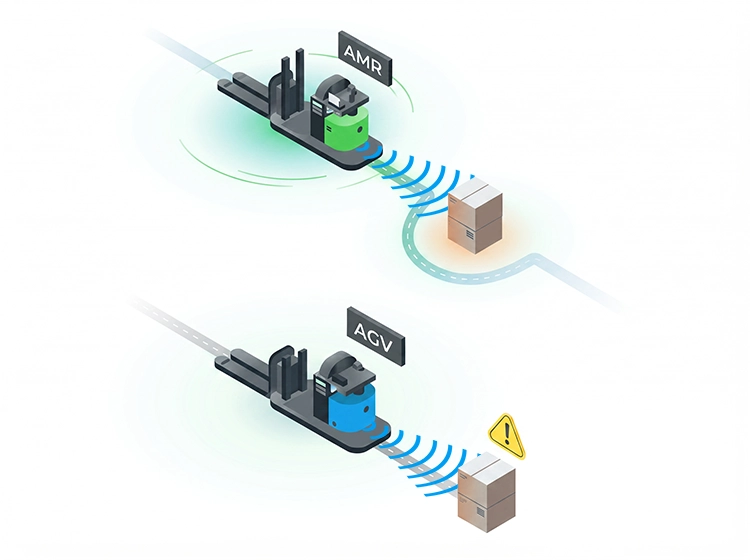
The transition from traditional Automated Guided Vehicles (AGVs) constrained by magnetic tape to dynamically routing Autonomous Mobile Robots (AMRs) represents a paradigm shift in material handling. This evolution has forced environmental perception systems to mature from single-dimensional binary triggers to complex, omnidirectional spatial reasoning.

Today’s industrial mobile robots rely heavily on advanced SLAM (Simultaneous Localization and Mapping) architectures, predominantly driven by 2D/3D safety lidars and sophisticated machine vision. These optical systems are exceptional at macro-level navigation and semantic mapping. However, when we analyze the kinematic envelope of a heavily loaded AMR operating at high speeds, a critical vulnerability emerges in the “last meter” of interaction.
In this near-proximity zone, the margin for error collapses. Braking distances become dictated by rigid physics, and sensor latency or failure can immediately result in hardware damage or personnel injury. Despite the rapid advancements in optical and computational technologies, acoustic sensing—specifically ultrasonic technology—maintains its position as the optimal, irreplaceable foundation for near-range AGV/AMR obstacle avoidance. This is not due to a lack of innovation in optics, but rather the immutable laws of physics: acoustic waves interact with physical matter in ways that light simply cannot replicate.
2. Deconstructing Physical Properties: Why Certain Environments Demand Acoustics
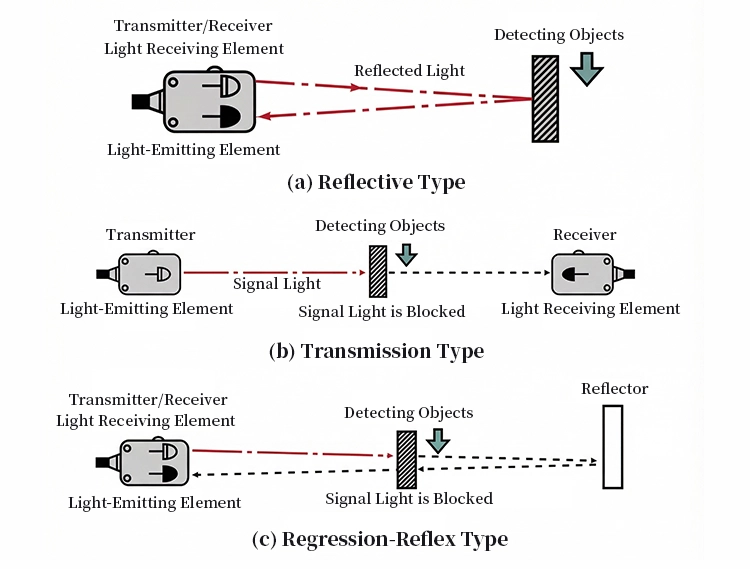
To understand the boundaries of modern robotic perception, engineers must look past sensor specifications and examine the fundamental physics of wave propagation. Optical sensors rely on the emission, reflection, and detection of photons. This mechanism is inherently vulnerable to the surface properties and atmospheric conditions of the operating environment.

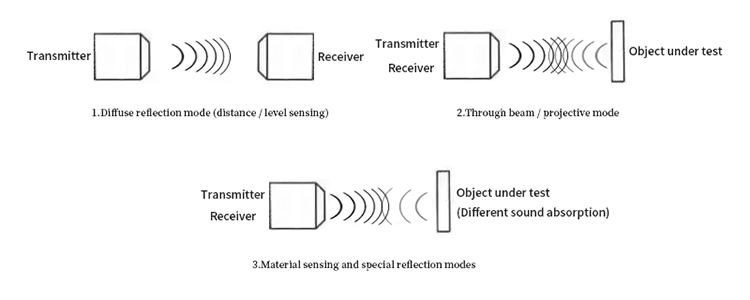
Acoustic sensing, conversely, utilizes mechanical wave propagation.

This fundamental difference dictates why acoustic sensors succeed precisely where optical systems fail.
2.1 The Penetration Dilemma: Transparent and Specular Materials
One of the most persistent engineering headaches in intralogistics is lidar failure on transparent objects. Safety lidars typically operate in the near-infrared spectrum (e.g., 905nm or 1550nm). When these laser pulses encounter a glass cleanroom door, a poly-carbonate partition, or a pallet tightly wrapped in LLDPE (Linear Low-Density Polyethylene) stretch film, the photons often transmit entirely through the material or scatter unpredictably. To the robot’s navigation stack, a massive, shrink-wrapped pallet may appear as empty, traversable space.
Specular (mirror-like) surfaces present an equally dangerous edge case. Stainless steel machinery or polished aluminum transit cases act as mirrors for near-infrared light. If the laser beam strikes a specular surface at an angle, the photons reflect away from the sensor’s receiver, resulting in a complete loss of return signal.
Acoustic waves completely bypass these optical vulnerabilities. Because sound is a mechanical wave, its reflection is triggered by a sudden change in medium density (the boundary between air and the solid object), entirely independent of optical transparency or surface gloss. An ultrasonic pulse will reliably bounce off a clear pane of glass or a highly polished metal cylinder, providing a deterministic distance measurement where a lidar would register a critical false negative.
2.2 Uncompromising Robustness in Extreme Environments
Industrial environments are rarely sterile. Facilities such as woodworking plants, flour mills, and machining centers with heavy atomized coolant present severe challenges for optical sensors.
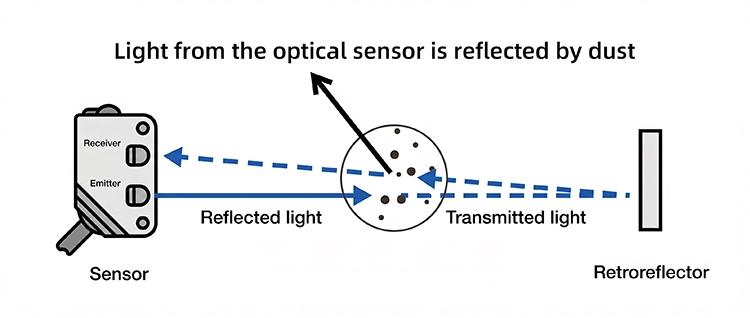
When a lidar pulse or camera lens is subjected to heavy airborne particulates or water mist, the system suffers from optical scattering. The light reflects off the dust particles mid-air, causing the navigation system to register “phantom” obstacles—halting the robot unnecessarily—or worse, blinding the sensor entirely and triggering a localized safety fault.

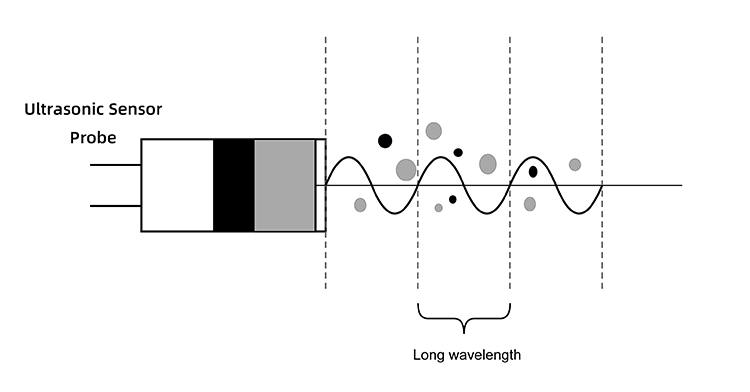
This is where the physical scale of the sensor’s operating wavelength becomes critical. Optical wavelengths are measured in nanometers, making them highly susceptible to scattering by microscopic dust and moisture. Industrial ultrasonic frequencies (such as 58kHz) have a wavelength in the millimeter range (approximately 5.9 mm in air at room temperature). Because the wavelength of the sound waves emitted by the 超声波传感器 is significantly larger than that of suspended particulates, the sound waves diffract around dust and water mist without losing their structural integrity. This physics-based advantage guarantees a high signal-to-noise ratio, ensuring unparalleled robustness in warehouse environments that would routinely incapacitate optical systems.

2.3 Color-Independent Perception and Acoustic Impedance
A frequently overlooked failure mode of optical perception is signal absorption by dark, non-Lambertian surfaces. Light-absorbing materials, such as black rubber tires, dark plastic totes, or deep-colored fabrics, absorb the vast majority of the near-infrared photons emitted by a lidar or active structured-light camera. If the return signal drops below the sensor’s detection threshold, the obstacle effectively disappears from the robot’s local map.
Acoustic reflection operates on an entirely different physical principle known as acoustic impedance (Z), which is defined as the product of the material’s density (ρ) and the velocity of sound within that material (V):
When an ultrasonic wave traveling through air hits an object, the strength of the returning echo is determined solely by the mismatch in acoustic impedance between the air and the target object. It has absolutely zero correlation with the object’s pigmentation or light-absorbing characteristics. To an ultrasonic sensor, a Vantablack rubber tire and a brightly painted white tire present the exact same acoustic impedance boundary, yielding an identical, highly reliable echo profile. This color-independence makes acoustic sensors critical for detecting low-reflectivity hazards on the warehouse floor.
3. Engineering Logic: Dimensions of Near-Range Obstacle Avoidance
Translating the physical advantages of acoustic perception into practical robotic control requires deep integration at the controller level. When an AMR weighing 1,000kg operates at speeds exceeding 1.5 m/s, the kinetic energy involved dictates strict, unyielding kinematic boundaries. The near-range sensor suite must convert raw analog echoes into deterministic stopping logic.

3.1 Response Speed and Kinematic Braking Distance
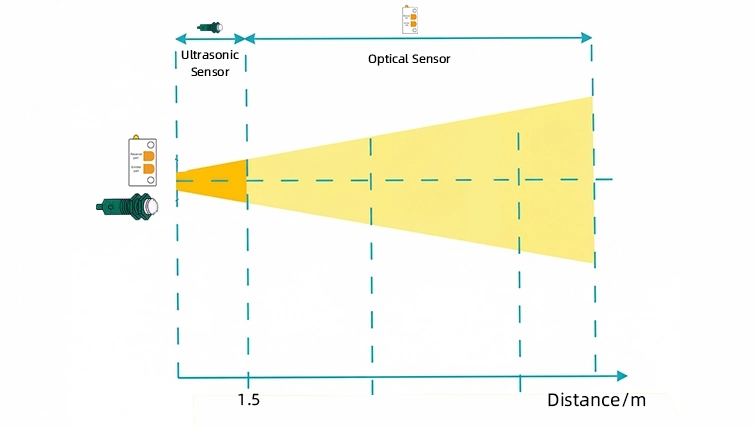
Within the critical 0.5m to 1.5m collision threshold, navigation systems cannot afford the computational latency associated with dense 3D point cloud processing or deep learning inference cycles. In this emergency zone, time is literal distance.
超声波传感器 calculate distance using the highly deterministic Time of Flight (ToF) principle. By measuring the precise interval between the emission of a burst and the reception of its echo, the sensor outputs a low-latency, hardware-level distance metric. Because this data is mathematically lightweight, it bypasses heavy CPU computation and can be routed directly to the AMR’s motor controller or safety PLC via protocols like IO-Link or CAN FD. This ensures that an emergency E-stop trigger is executed within milliseconds, strictly adhering to the calculated braking curve required to prevent a collision.
3.2 Blind Spot Compensation and Volumetric Protection
Standard 2D safety lidars are the industry norm for primary AGV routing, but they project a single planar slice of light—typically positioned 15 to 20 centimeters off the floor. This architectural reality creates severe blind spots both below and above the scanning plane. Forklift tines, suspended loads, open dock doors, or overhanging shelving can easily bypass a 2D scan, leading to catastrophic strikes.
To achieve robust near-range safety compensation, roboticists leverage the specific acoustic lobe characteristics of ultrasonic transducers. Through rigorous beam pattern planning, engineers can select sensors with specific dispersion angles (e.g., a wide 60° cone for general reversing, or a narrow 15° beam for navigating tight aisles). This creates a 3D volumetric protective envelope rather than a 2D slice. This acoustic cone effectively acts as a physical bumper, sweeping the air volume from the floor level up to the vehicle’s maximum height, guaranteeing multi-dimensional hazard detection.
3.3 Precision Docking and Fine Manipulation
While obstacle avoidance is a primary function, near-range sensing is equally critical for operational precision. When an AMR initiates a docking sequence with a charging station or aligns to lift a customized material tote, optical systems often struggle due to minimum focal lengths, localized shadowing from the robot’s own chassis, or target blinding by the charging station’s indicator lights.
High-frequency acoustic sensors (operating in the 200kHz to 300kHz range) are engineered for micro-proximity detection. These transducers offer millimeter-level resolution at ranges as close as 3 to 5 centimeters. By providing continuous, un-obscured micro-distance feedback to the motion controller, the AMR can execute a smooth, critically damped deceleration profile, engaging physical contacts or payload interfaces without mechanical shock.
4. Industry Bottleneck Research: Multi-Vehicle Coordination and Environmental Compensation
Scaling an AMR deployment from a single prototype to a fleet of 50 orchestrated units introduces severe environmental and signal integrity challenges. A robust perception layer must mitigate these real-world bottlenecks at the hardware and firmware levels.
4.1 Solving Crosstalk in Dense Fleets
As fleet density increases, the probability of acoustic interference skyrockets. When two AMRs navigate past each other in a narrow warehouse aisle, they are firing acoustic pulses into the same airspace. If Robot A’s receiver interprets the echo of Robot B’s pulse as its own, the system registers a phantom object at a dangerously close range, triggering an unnecessary panic stop.
Crosstalk suppression in multi-vehicle coordination is handled through several sophisticated techniques. Advanced controllers utilize Time-Division Multiplexing (TDM), synchronizing the fleet via industrial Wi-Fi or 5G to ensure neighboring robots fire their pulses in microsecond-coordinated time slots. Alternatively, asynchronous systems utilize pseudo-random pulse encoding—where each transducer emits a uniquely coded acoustic signature. The sensor’s DSP (Digital Signal Processor) runs a cross-correlation algorithm on the returning echo, instantly filtering out any acoustic waves that do not carry its specific mathematical “fingerprint.”
4.2 Temperature Compensation and Dynamic Calibration
Unlike the speed of light, the speed of sound in a gaseous medium is highly sensitive to thermodynamic changes. In an industrial facility, the velocity of an acoustic wave v is primarily dictated by the ambient air temperature T (in degrees Celsius), expressed by the formula:
For engineering approximations, this is often simplified to:
If an AGV moves from a −20°C cold storage freezer out to a +30°C loading dock, the velocity of the ultrasonic wave changes by approximately 30 m/s. Without correction, this physical drift would cause severe distance calculation errors, compromising the braking distance logic. To counter this, industrial-grade ultrasonic sensors feature integrated NTC thermistors. The sensor’s microcontroller continuously polls the localized temperature and dynamically adjusts the ToF algorithm multiplier, ensuring the distance calculation remains pinpoint accurate across violent thermal gradients.
4.3 Advanced Background Suppression

In automated warehousing, aisles are often only a few centimeters wider than the AMR itself. As the robot drives parallel to continuous steel racking or block walls, the acoustic cone will naturally bounce off the static infrastructure. If unmitigated, the robot would perceive the wall as an immediate collision threat.
To filter out the facility’s architecture, engineers employ dynamic background suppression algorithms. During the commissioning phase, the sensor array is dynamically gated. The firmware establishes an adaptive distance threshold based on the robot’s current odometry and map position. Echoes returning from outside this dynamic spatial window—or echoes that remain mathematically static over time (like a continuous wall)—are heavily filtered by the DSP. The system is fundamentally trained to ignore fixed geometric structures and trigger a safety fault only when a dynamic intrusion (such as a human stepping into the aisle or a dropped box) breaches the established time-distance envelope.
5. Architectural Perspective: The Future of Multi-Sensor Fusion
As autonomous navigation matures, leading robotics engineers no longer view sensor modalities as competing technologies. Instead, the industry has universally adopted the multi-sensor fusion architecture, a design philosophy where diverse physical sensors are integrated to compensate for each other’s inherent blind spots.
5.1 Strategic Role Allocation: The Perception Pyramid
To build a highly robust autonomous system, perception is structured hierarchically—much like a pyramid—where each layer serves a distinct, specialized function:
- Top Layer (Macro-Navigation): 2D/3D Lidars manage the global map. They are responsible for long-range SLAM, dynamic path planning, and identifying structural landmarks. They provide the “Where am I, and how do I get to my destination?” logic.
- Middle Layer (Semantic Understanding): Machine Vision and RGB-D cameras handle Object ID. By leveraging neural networks, this layer performs semantic segmentation—differentiating a forklift from a pedestrian, or reading QR codes on a tote. It answers the “What exactly am I looking at?” question.
- Base Layer (Micro-Proximity & Safety): Acoustic and ultrasonic sensors form the foundational Safety Redundancy layer. They operate purely on physical proximity and density, devoid of complex semantic interpretation. They answer the most critical question: “Is there a physical mass immediately in front of me, regardless of what it looks like?”
5.2 The Fail-Safe Principle and Heterogeneous Redundancy
In the realm of functional safety, the fail-safe principle dictates that if a system encounters an unrecoverable error or sensor blinding, it must default to a state that causes zero harm—typically a localized hard stop.
Achieving a true fail-safe state requires heterogeneous redundancy. If an AMR uses two optical sensors (e.g., a lidar and a camera) for its safety loop, it possesses homogeneous redundancy. If a sudden glare of sunlight blindingly floods the aisle, or a thick cloud of steam is released, both optical sensors share the same physical vulnerability and may fail simultaneously.
By integrating acoustic sensors into the base layer, engineers introduce a completely independent physical variable (mechanical sound waves) into the safety loop. If the optical layer fails or degrades, the AMR’s localized safety loop remains perfectly intact, relying on the acoustic layer’s tactile-like spatial awareness to execute a safe deceleration.
6. Conclusion: Establishing a Deterministic Safety Boundary
The true engineering value of acoustic technology in industrial automation lies in its absolute, unyielding certainty. Ultrasonic sensors are not designed to replace the vast spatial mapping capabilities of lidar, nor the rich semantic data of machine vision. Rather, they serve as the “robustness bedrock” for complex, extreme, and near-proximity operations.
For manufacturers, fleet operators, and systems integrators adhering to stringent quality and safety standards—such as ISO 9001 for industrial manufacturing or the rigorous IATF 16949 standard for automotive-grade reliability—designing an AMR that relies solely on one type of physical wave is an unacceptable engineering liability.
By deeply understanding the inherent physical boundaries of optical sensors and intentionally weaving acoustic technology into the hardware architecture, engineers can build automated systems that do not merely navigate intelligently in pristine laboratories, but operate with deterministic, guaranteed safety margins in the chaotic reality of the modern factory floor.
常见问题
Q1: Why are ultrasonic sensors better than LiDAR or cameras for AMR near-range obstacle avoidance?
A1: While LiDAR and cameras are excellent for long-range mapping and navigation, they have significant blind spots in near-range scenarios (typically within 0 to 20 cm). Optical sensors struggle with transparent materials (like glass doors), highly reflective surfaces, or pitch-black environments. AGV ultrasonic sensors, relying on mechanical sound wave propagation, are completely immune to surface color, transparency, or lighting conditions. By integrating industrial ultrasonic sensors into an AMR’s perception system, manufacturers can eliminate near-range blind spots and ensure collision-free high-speed operations even in complex environments.
Q2: Can AGVs and AMRs detect transparent glass or highly reflective obstacles reliably?
A2: Standard optical sensors often fail to detect these materials, leading to potential collisions and safety hazards in warehouses or factories. To solve this, automated material handling systems must utilize acoustic sensing. High-performance ultrasonic transducers emit sound waves that bounce back from glass, metal, or glossy surfaces just as effectively as they do from solid walls. Equipping your robots with precision ultrasonic sensors for obstacle avoidance guarantees that transparent or reflective objects are detected accurately within the critical near-range boundary.
Q3: How does airborne dust or dirt affect an AGV’s obstacle detection system?
A3: Airborne particulates like heavy dust, smoke, or floating fibers can scatter optical signals, causing false alarms or completely blinding vision-based systems. Unlike optical methods, acoustic waves are highly resilient to airborne interference. Industry ultrasonic sensors manufactured by ISSR are designed to operate reliably in these harsh industrial environments. Their robust acoustic propagation ensures continuous, accurate distance measurement and near-range obstacle avoidance without requiring constant lens cleaning or maintenance.
Q4: What is the optimal sensor fusion strategy for complete AGV/AMR environmental perception?
A4: The most effective and safe perception architecture uses a multi-sensor fusion approach. LiDAR and 3D vision cameras should be used for long-to-mid-range SLAM (Simultaneous Localization and Mapping) and trajectory planning. However, for the crucial “last meter” of safety, a network of near-range ultrasonic sensors must be deployed around the chassis. This combination compensates for optical limitations, providing a fail-safe hardware boundary. When selecting components, partnering with a professional ultrasonic sensor manufacturer ensures that the transducer’s frequency, beam angle, and response time are perfectly customized for your AMR’s speed and control logic.