










1. Foreword: The “Engineering Gamble” of Level Measurement
In today’s rapid development of Industry 4.0 and Smart Water Management, level data acquisition has long surpassed merely “looking at a reading.” It serves as the core trigger condition for Predictive Maintenance, inventory management, and system automation linkage in the modern process industry.
When engineers face level monitoring requirements for storage tanks, open channels, or reactors, the selection process is by no means just a showdown of nominal accuracy at the sensor’s factory departure. Instead, it is a long-term engineering gamble concerning installation complexity, Mean Time Between Failures (MTBF), anti-interference capability, and long-term Total Cost of Ownership (TCO).
Among numerous technological schools of thought, ultrasonic technology based on the Time-of-Flight (ToF) principle and hydrostatic/pressure measurement based on Pascal’s Law constitute the two most mainstream camps in current industrial sites. As a professional manufacturer (ISSRSensor) deeply engaged in the R&D of core ultrasonic components and sensors for 20 years, we will strip away the packaging of marketing jargon in this article. Starting from physical principles and actual pain points in real-world conditions, we will provide you with a profound analysis of the objective differences and application boundaries between these two technologies.
2. Ultrasonic Level Transmitters: The Generational Advantage of Non-Contact Measurement Technology
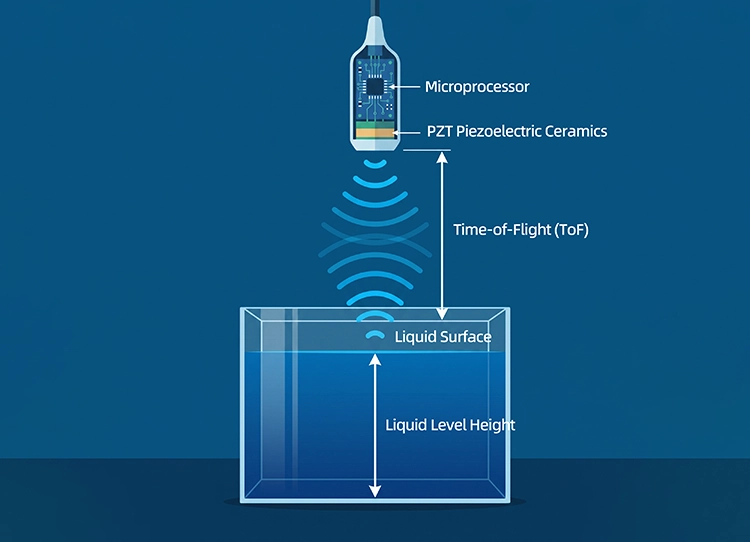
The core principle of the ultrasonic level sensor is to generate high-frequency mechanical waves through piezoelectric ceramics (such as PZT materials) inside the probe. After the sound waves hit the liquid surface and reflect, the microprocessor calculates the exact “Time-of-Flight (ToF)” of the sound waves’ round trip and combines it with the ambient speed of sound to derive an accurate liquid level height. This technology demonstrates an overwhelming generational advantage in modern industry, with its core defining word being: Non-contact.
2.1 Innate “Cleanliness”: Non-Contact is Productivity
In harsh chemical or water treatment environments, the sensor’s greatest enemy is often the medium itself. Traditional contact sensors submerged in liquid for long periods inevitably suffer physical damage. The “non-contact” nature of ultrasonic sensors makes them completely immune to the following lethal conditions:
Defense Against Strong Corrosives: When facing strong acids and alkalis (like sulfuric acid or sodium hydroxide solutions), the ultrasonic probe is suspended high above the liquid surface, completely isolating the corrosion path from a physical standpoint. Combined with anti-corrosion housing designs like those provided by ISSRSensor, the equipment’s lifespan is exponentially extended.
Rejecting Crystallization and Material Buildup: In high-concentration brine, syrup, or wastewater treatment containing suspended solids, contact probes are extremely prone to medium adhesion (material buildup) or even crystallization, leading to measurement distortion. Ultrasonic sensors do not have to worry about grease, chemicals, or solid suspended particles in wastewater attaching to the probe. This is particularly crucial in food manufacturing (ensuring hygiene standards) and municipal water affairs, truly realizing that “non-contact is productivity.”
2.2 Astounding Micron-Level Accuracy and Sensitivity
People often mistakenly believe that non-contact measurement is less accurate than contact measurement, but this is already history in the face of modern ultrasonic technology. Thanks to leaps in basic materials science and electronic signal processing, the sensitivity of ultrasound has reached unprecedented heights.
- Extremely High Spatial Resolution: Paired with an advanced AFE (Analog Front-End) signal processing architecture, top-tier modern ultrasonic sensors can achieve spatial resolutions up to 20 microns.
- Capturing the Liquid Surface’s Micro-Breathing: Even if the liquid surface has a minute fluctuation of just half a teaspoon’s volume, this change in energy reflection can be keenly captured by high-frequency sound waves through an extremely short flight time difference.
- Dynamic Temperature Compensation: Excellent industrial ultrasonic sensors integrate high-precision thermistors inside the probe. In the face of sound speed variations caused by day-and-night temperature differences inside the tank, the microprocessor executes dynamic sound speed compensation, ensuring millimeter-level absolute accuracy is maintained even in complex environments from -20°C to 70°C.
2.3 The Ideal Partner for the IoT Era: Ultra-Low Power Consumption and Intelligent Algorithms
With the popularization of the Internet of Things (IoT) in industrial scenarios, remote monitoring nodes have imposed extremely harsh requirements on sensor power consumption, which happens to be another major home court for ultrasonic technology.
- Microampere-Level Power Management: The latest ultrasonic sensor architecture can achieve an astonishingly low power consumption of 25μA in standby mode. This ultra-low power consumption feature makes it perfectly adaptable for solar-powered systems in remote areas or battery-powered NB-IoT/LoRaWAN remote level monitoring nodes.
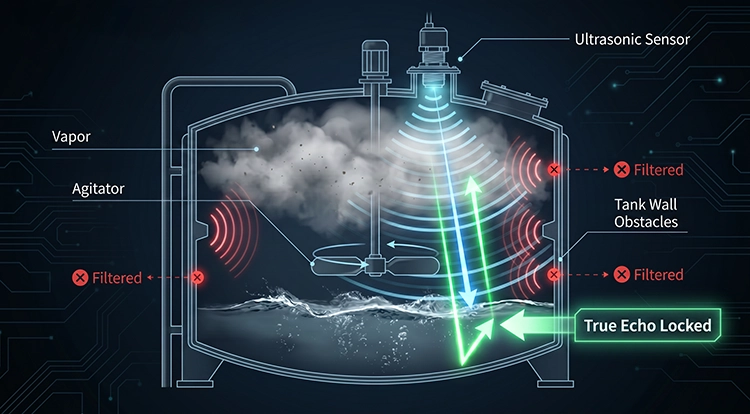
- An “Intelligent Brain” that Penetrates Interference: An industrial site is by no means a laboratory; storage tanks are often filled with vapor, dust, or equipped with agitators. Modern ultrasonic sensors are not just “sound emitters” but also “analyzers.” Through advanced False Echo Suppression algorithms and envelope recognition technology, the sensor can intelligently identify and filter out noise generated by tank wall obstacles and steam interference, accurately locking onto the true liquid surface echo.
3. Hydrostatic/Pressure Level Transmitters: The Stable Foundation of Industrial Tradition
Although ultrasonic technology is rapidly dominating the mainstream market, as a veteran industrial solution, pressure (or Differential Pressure, DP) level transmitters still hold their value in specific fields. As a professional sensor solution provider, we need to view their physical foundation objectively.
3.1 Measurement Logic: Indirect Calculation Based on Pascal’s Law
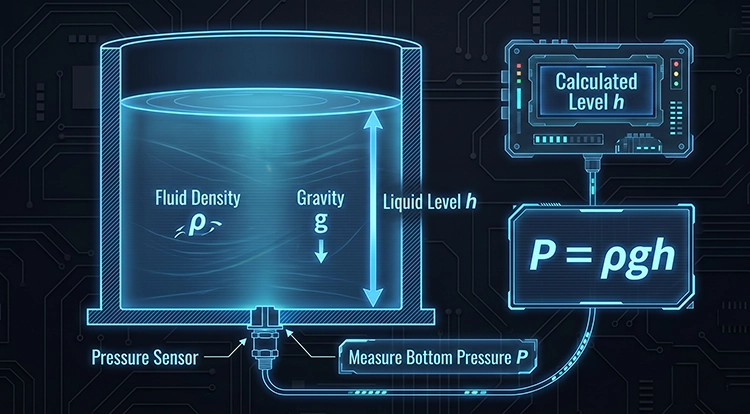
The underlying logic of a pressure level transmitter is very straightforward: based on Pascal’s Law in fluid mechanics, the hydrostatic pressure at the bottom of the liquid equals the product of the fluid density, gravitational acceleration, and liquid level height (Formula: P = ρgh). The sensor measures the pressure P at the bottom and uses the preset medium density ρ in the system to reversely calculate the liquid level height h. This is a highly mature indirect measurement technology.
3.2 The Unique Value and Irreplaceable “Comfort Zone” of Pressure Measurement
Under certain extreme physical boundaries, the propagation of sound waves is fatally obstructed. At this time, pressure measurement exhibits exceptionally strong robustness:
- Extreme Temperature and Pressure: In ultra-high temperature and high-pressure boilers exceeding 150°C, or inside sealed reactors with extreme vacuum (where the medium for sound wave propagation is lacking), ultrasonic technology will fail, while the pressure diaphragm can still work by relying on physical compression.
- Extremely Thick Foam Layers: When a dense, sound-absorbing foam layer tens of centimeters thick exists on the liquid surface, the ultrasonic signal will be severely attenuated or even completely absorbed. Because foam generates almost no significant hydrostatic pressure, a hydrostatic level transmitter can directly “ignore” the foam and accurately measure the weight and height of the true underlying liquid.
3.3 Scientific Limitations: The Other Side of the Coin
Without disparaging traditional technology, the objective engineering challenges it faces must be clarified:
- Fatal “Density Dependency”: Looking closely at the formula P = ρgh, if the liquid’s temperature changes, or the medium’s chemical concentration alters, its density ρ will fluctuate. This means that even if the liquid level height h remains completely unchanged, the pressure value P output by the sensor will vary, causing the system to calculate false liquid level fluctuations.
- Contact Failure and Physical Damage Risks: The core components of a pressure transmitter (such as 316L stainless steel or Hastelloy diaphragms) must be submerged in the medium over the long term. Highly corrosive liquids will erode the diaphragm, sediment will abrade it, and viscous liquids can easily clog the pressure guiding holes at the bottom, triggering catastrophic measurement failures.
4. Engineering Practice: Installation Complexity vs. Total Cost of Ownership (TCO) Comparison
Industrial procurement looks at far more than just the sensor’s “BOM hardware cost”; senior instrument engineers pay more attention to the equipment’s Total Cost of Ownership (TCO). TCO encompasses the equipment’s installation labor, downtime maintenance costs, and calibration expenses over its lifecycle.
4.1 Installation Flexibility: The Safety Gamble of Top-Mounted vs. Side/Bottom-Mounted
- The “Zero Penetration” Safety Rule of Ultrasound: The vast majority of ultrasonic level sensors utilize a top-mounted flange/thread setup. This layout means no mechanical openings are required on the bottom or sides of the storage tank, fundamentally eliminating the physical paths for hazardous chemicals (like acids or toxic solvents at the tank’s bottom) to leak. For pressure vessels, a top-mounted ultrasonic solution can also greatly reduce the difficulty of safety certifications for the container.
- The High Installation Price of Pressure/Differential Pressure Types: If it is an open tank, the hydrostatic type needs to be dropped to the bottom of the liquid; if it is a closed pressure tank, installing a DP Transmitter is extremely complex. Not only do openings need to be made at the top and bottom of the tank, but high and low-pressure Impulse Lines must also be laid. If the medium is volatile and prone to condensation, instrument engineers even have to design complex Dry Leg and Wet Leg piping systems and inject isolating fluid into the pipes. This is not only extremely sensitive to installation angles, but the piping system itself becomes a massive potential Leak Point.
4.2 Calibration and Maintenance Cycles: The “Invisible Black Hole” of Labor Costs
- Pressure Type: Long-Term Calibration Dependency: The maintenance of traditional differential pressure level transmitters heavily relies on manual labor. Due to diaphragm aging and environmental stress, the equipment is extremely prone to Zero Drift. Furthermore, when dealing with media containing numerous impurities, maintenance personnel need to periodically perform “Purging” operations to clean the impulse lines. If the type of liquid in the tank is changed (altering the density), the instrument technician must use a handheld communicator to re-perform range migration and density calibration.
- Ultrasound: Minimalist On-Site Calibration and the Ultimate “Maintenance-Free” Form: Traditional instrument calibration often requires complex Hart handheld communicators or host software. However, advanced ultrasonic sensors adopt a highly practical “Teach-in” design utilizing an external pigtail wire on-site. The instrument engineer does not need to carry any external configuration equipment; simply short-circuiting the dedicated external teach wire to the positive (VCC) and negative (GND) terminals of the power supply can quickly complete the learning and locking of the measurement range (full scale and zero point). This purely physical wire-controlled calibration method completely eliminates the risks of on-site button aging and water ingress failures, and it also bypasses the limitations of complex communication protocols. Once calibration is complete, thanks to the “no moving parts” and non-contact nature of the device, it subsequently enters a virtually “Install and forget” maintenance-free state, drastically reducing long-term operational and maintenance labor expenses.
5. Industry Application Decision Matrix (In-Depth Engineering Selection Guide)
There is no absolute perfection in technology, only the most suitable physical match for the working conditions. To help instrument engineers avoid “selection disasters,” we have outlined the following selection decision guide based on years of acoustic R&D and on-site engineering experience, from the underlying dimensions of fluid mechanics and acoustics.
5.1 Scenarios and Principles Where “Ultrasonic Level Sensors” Are Highly Recommended
As long as the physical environment allows mechanical sound waves to propagate stably, ultrasound is a mandatory choice for the following scenarios due to its absolute advantages of being maintenance-free, non-contact, and highly sensitive:
5.1.1 Chemical and Pharmaceutical Industries (Extreme Corrosion and High Cleanliness):
Engineering Pain Point: When facing concentrated sulfuric acid or hydrochloric acid, traditional contact instruments often require expensive Hastelloy or Tantalum metal diaphragms, and are highly susceptible to leakage due to “Capillary Action.”
Ultrasonic Advantage: Ultrasonic level transmitters using PTFE (Polytetrafluoroethylene) or PVDF fully encapsulated transducer probes are suspended high above the liquid surface, completely severing the corrosion path from a physical level. In the food and pharmaceutical industries (CIP/SIP cleaning conditions), the non-contact feature also perfectly circumvents the risk of bacterial growth caused by dead zones in contact probes.
5.1.2 Smart Water Affairs and Environmental Engineering (Complex Suspended Solids and Narrow Pump Stations):
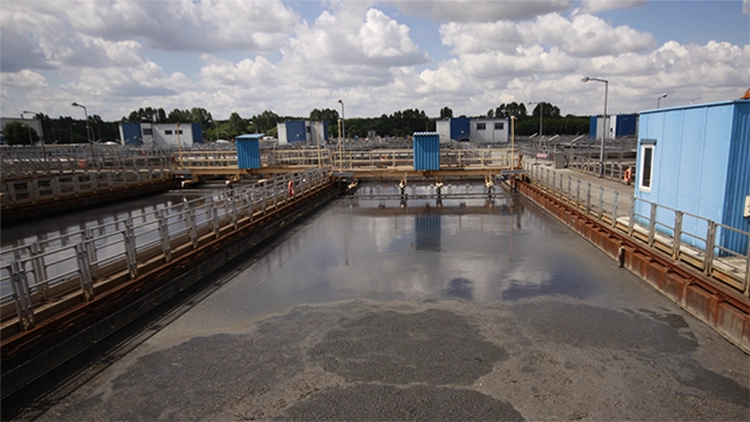
Engineering Pain Point: Hair, sediment, and grease in wastewater easily clog the impulse lines of pressure level transmitters, leading to measurement paralysis.
Ultrasonic Advantage: Modern industrial-grade ultrasonic sensors possess excellent Acoustic Matching Layer technology and integrated False Echo Suppression algorithms. Even with debris floating on the water surface, or inside narrow underground pump stations equipped with climbing ladders, the sensor can emit a Narrow Beam Angle and utilize algorithms to filter out interference echoes generated by pipe walls and ladders, accurately locking onto the true water surface.
5.1.3 Fuel Energy and IoT Remote Monitoring (Microampere Power Consumption and Explosion/Vibration Resistance):
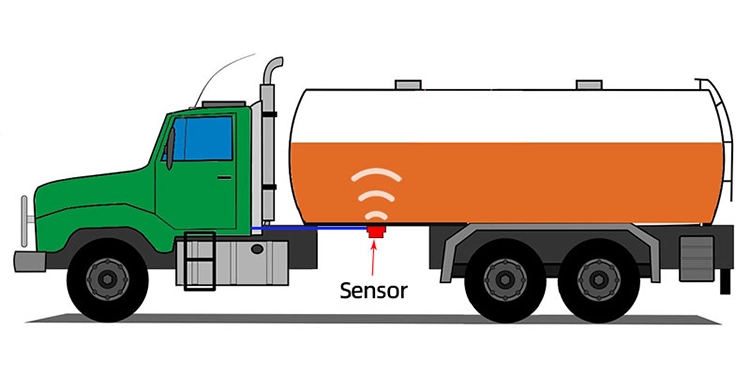
The Absolute Advantage of Ultrasound: For LPG (Liquefied Petroleum Gas) cylinders, mobile hazardous material tank trucks, and oil storage tanks at remote base stations, traditional tank penetrations for level measurement mean tremendous leakage hazards and exorbitant explosion-proof certification costs. Modern ultrasonic technology innovatively adopts a “non-penetrating, bottom-mounted, upward-penetrating detection” design—the sensor is directly attached to the external bottom of the container. High-frequency sound waves penetrate upward through the metal tank bottom into the liquid and reflect at the gas-liquid interface. This completely Non-invasive physical architecture fundamentally eliminates leak points in sealed high-pressure vessels, guaranteeing absolute explosion-proof safety. Meanwhile, its internal Solid-state nature (without any moving mechanical parts) allows it to exhibit excellent shock resistance against the severe bumps and high-frequency vibrations of mobile tank trucks. Coupled with its microampere-level standby power consumption, this externally mounted ultrasonic solution has become an irreplaceable data engine for battery-powered LoRaWAN/NB-IoT industrial telemetry terminals.
5.2 The Marginal Physical Boundaries Where “Pressure/Differential Pressure Level Transmitters” Must Be Retained
Ultrasound is not omnipotent. In the following extreme blind spots that break the “physical laws of sound wave propagation,” we must still rely on pressure measurements based on Pascal’s Law as a fallback:
- Sealed Systems with Ultra-High Temperatures and Severe Temperature Gradients: When the internal temperature of a storage tank is extremely high (such as steam boilers in thermal power plants), firstly, the excessive heat may exceed the “Curie Temperature” of the piezoelectric ceramics inside the ultrasonic probe, causing permanent failure of the piezoelectric effect. Secondly, severe temperature gradients will trigger Acoustic Refraction, causing sound waves to deviate from the receiver. At this time, heat-resistant pressure diaphragms must be relied upon.
- Extreme Vacuum Containers: Sound waves are mechanical waves and must rely on a medium (like air or gas) to vibrate and propagate. If a chemical reactor requires a high vacuum to be drawn during the process, the sound waves will “lose their carrier” and fail completely. In this case, contact hydrostatic measurement is the only solution.
5.3 Core Technical Parameters Horizontal Comparison Matrix (Engineers’ Cheat Sheet)
| Core Evaluation Dimension | Ultrasonic Level Transmitter (Ultrasonic ToF) |
Pressure/Hydrostatic Level Transmitter (Hydrostatic DP) |
|---|---|---|
| Measurement Principle | Sound wave Time-of-Flight (ToF) – Non-contact | Hydrostatic pressure (P = ρgh) – Contact immersion |
| Impact of Medium Density Changes | Completely unaffected (Accurate regardless of density changes) |
Extremely sensitive (Density changes lead to huge errors) |
| Anti-Viscosity/Crystallization Ability | Excellent (No contact with liquid, no risk of material buildup) | Extremely poor (Highly prone to clogging impulse holes or encasing the diaphragm) |
| Vacuum Condition Adaptability | Cannot function (Requires a medium for sound wave propagation) |
Excellent (Relies on physical compression to work) |
| Mechanical Wear and Zero Drift | No mechanical parts, zero drift for life | Diaphragm is subject to metal fatigue, easily resulting in zero drift |
| Daily Maintenance Needs | Virtually maintenance-free (No purging/cleaning required) |
Requires regular cleaning of impulse lines, purging, and density recalibration |
| Long-Term Total Cost of Ownership (TCO) | Extremely low (Saves significant labor and downtime costs) |
Relatively high (Consumes higher labor for inspections and calibration maintenance) |
6. Conclusion: The Inevitable Choice for Digital Transformation and Expert Call to Action
Looking back at the development history of industrial process control, the popularization of every measurement technology is essentially driven by the pursuit of higher system reliability and lower Total Cost of Ownership (TCO).
Although the cornerstone position of pressure level transmitters in extreme environments like high temperatures and vacuums remains unshakeable, looking broadly at the digital transformation of modern Industry 4.0, the rigid demand for “maintenance-free” equipment, and the tolerance for complex and harsh media, the ultrasonic non-contact technology based on the ToF principle undoubtedly offers a superior comprehensive lifecycle return on investment. It completely breaks the engineering curse of traditional contact instruments that require frequent calibration, purge cleaning, and are highly susceptible to corrosion.
FAQ
Q1: What is the “Dead Band” of an ultrasonic level transmitter? Does it affect measurement?
A1: The dead band is a physical phenomenon where the ultrasonic transducer produces a “Ringing” effect when emitting sound waves. During this extremely short ringing period, the sensor cannot receive reflected echoes. Therefore, there is a small distance directly below the probe that cannot be measured (usually ranging from 10cm to 50cm, depending on the range). During installation, you only need to ensure that the maximum liquid level (full scale) does not enter this dead band. If your tank space is extremely constrained, ISSRSensor can provide customized high-frequency, narrow dead band transducer solutions.
Q2: Can I still use an ultrasonic level transmitter if there is thick foam on the liquid surface inside the storage tank?
A2: This depends on the physical properties of the foam. If it is a light foam that easily bursts (such as saponification liquid), ISSRSensor’s low-frequency transducers combined with penetration algorithms can handle it easily. However, if it is a dense, sound-absorbing foam up to tens of centimeters thick (like in beer fermentation tanks or certain chemical reactors), the ultrasonic signal will be severely absorbed, leading to “lost echoes.” In this case, we usually recommend switching to a guided wave radar level transmitter, or using a traditional hydrostatic level transmitter, because hydrostatic measurement is unaffected by surface foam.
Q3: Will drastic fluctuations in ambient temperature cause the ultrasonic level transmitter to become “inaccurate”?
A3: Traditional uncompensated ultrasonic probes are indeed affected, because the speed of sound propagation in the air changes with temperature (for every 1℃ change in temperature, the speed of sound changes by approximately 0.6m/s). However, modern industrial-grade ultrasonic level transmitters (like the ISSR series products) integrate high-precision thermistors inside the probe, enabling microsecond-level dynamic sound speed compensation. As long as it is within a conventional industrial environment of -20℃ to 70℃, temperature fluctuations will not have any substantive impact on the final millimeter-level accuracy.
Q4: Can an ultrasonic level transmitter be used in pressurized (pressure tanks) or vacuum sealed storage tanks?
A4: It can be used in pressurized storage tanks, but absolutely not in vacuum tanks. Ultrasound is a mechanical wave and must rely on a medium (such as air or nitrogen) to vibrate and propagate. Within a certain positive pressure range, ultrasound can function normally (sound waves even propagate better in dense gases). However, if it is a container with a high vacuum drawn, the sound waves will lose their propagation medium, causing the sensor to fail. For vacuum tanks, you must choose a pressure/differential pressure level transmitter to measure physical compression.
Q5: When measuring highly corrosive liquids like concentrated sulfuric acid or hydrochloric acid, is it better to choose a pressure type or an ultrasonic type?
A5: It is highly recommended to choose an ultrasonic level transmitter. Pressure level transmitters must submerge a metal diaphragm into the medium. When facing strong acids, extremely expensive Tantalum metal or Hastelloy must be used, and there is still a risk of leakage after long-term immersion. An ultrasonic level transmitter uses a non-contact top mounting, and the probe material can be fully encapsulated PVDF or PTFE (Polytetrafluoroethylene), completely isolating it from the erosion of highly corrosive liquids on a physical level. Its lifespan is typically 3 to 5 times that of contact instruments.
Q6: Compared to pressure transmitters, do ultrasonic level transmitters require frequent daily calibration or purging?
A6: Almost never. Traditional differential pressure transmitters are prone to “zero drift” due to the fatigue and metal stress of the mechanical diaphragm, and the impulse lines are easily clogged by impurities, requiring instrument technicians to routinely perform “purging” and zero-point calibration. Because the ultrasonic level transmitter has no mechanical moving parts internally (Solid-state) and does not contact the liquid, there are no issues with zero drift or clogging. Utilizing ISSRSensor’s unique “pigtail wire teach-in” function, once the initial installation and setup are complete, it can achieve a long-term, maintenance-free operation that is “install and forget.”
-

ISSRSensor 450mm Anti-Corrosion RS232 Output Ultrasonic Level Sensor for Wet-Dry Feeders & Corrosive Tanks
-
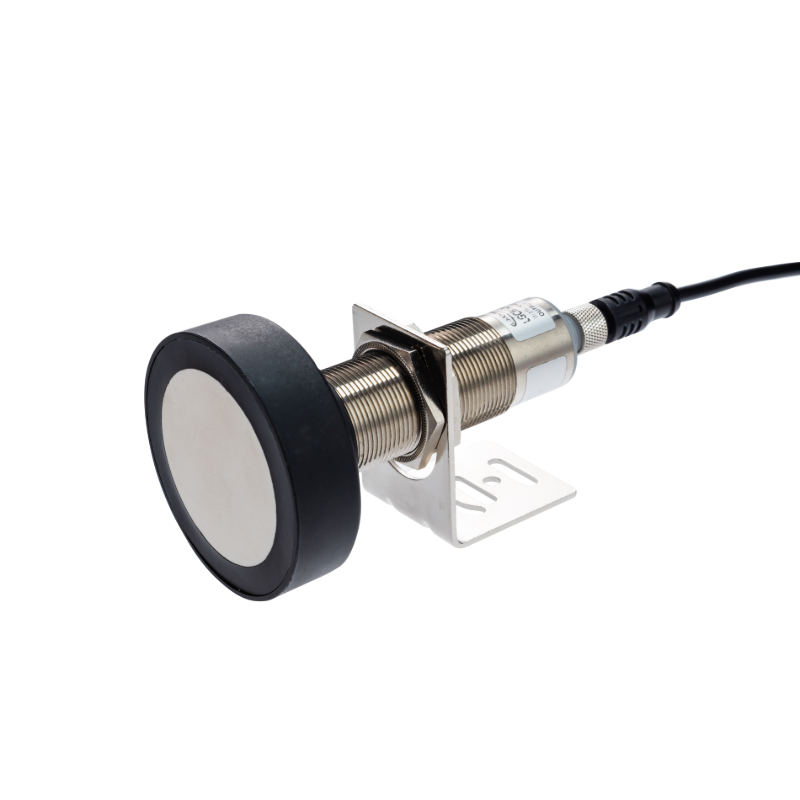
ISSRSensor 6M Ultrasonic Level Sensor|Multi-Output Analog/Switching/Digital
-
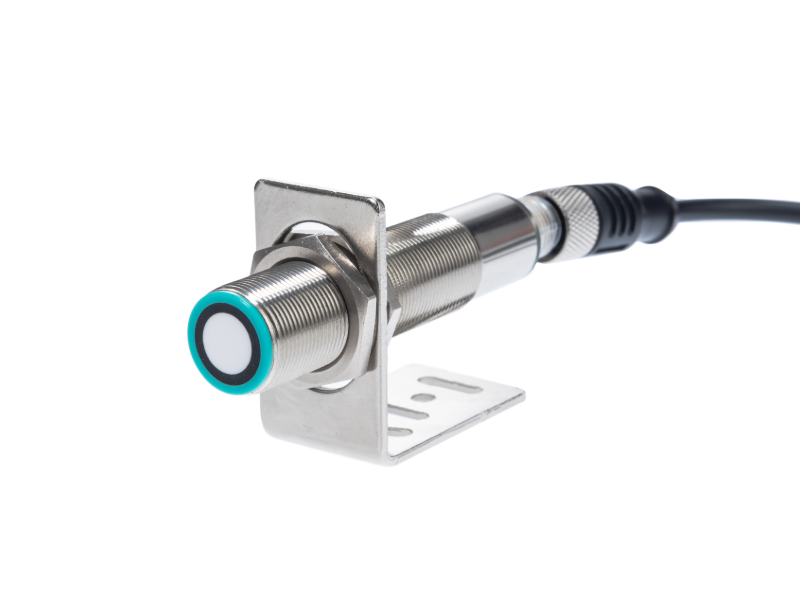
ISSRSensor All-in-One Ultrasonic Sensor: 1m Range Level & Object Detect
-
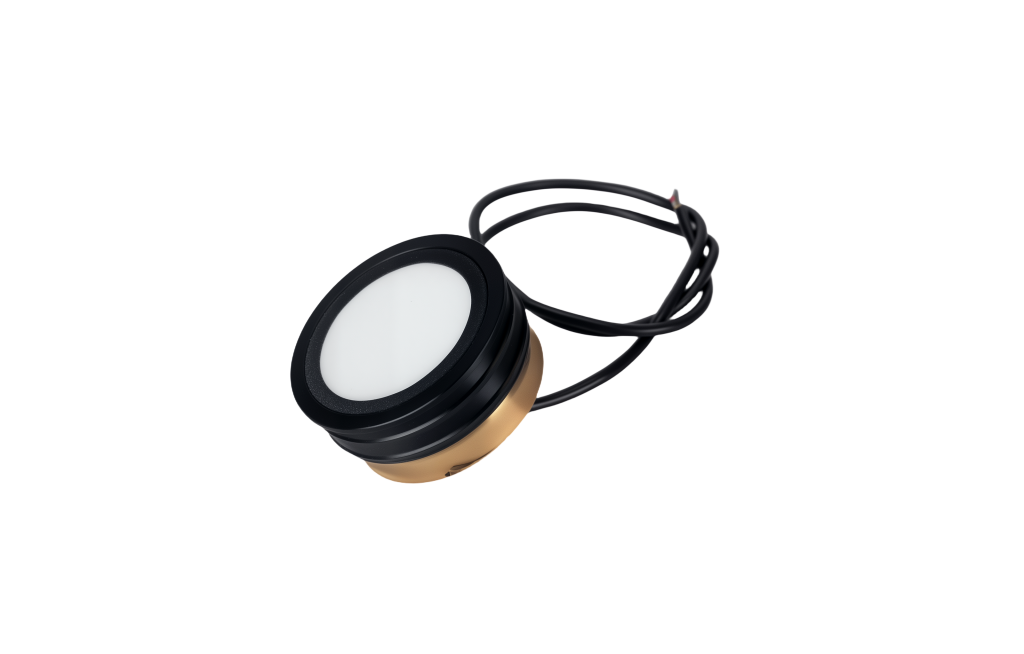
ISSRSensor 112 kHz Corrosion-Resistant Ultrasonic Transducer for Liquid/Solid Level Detection and Ranging