


Ultrasonic Sensors
ISSR’s ultrasonic sensors, based on piezoelectric transducer technology, use advanced acoustic principles to accurately measure objects and distances, with strong background suppression that maintains reliability in dusty, foggy, or otherwise challenging environments. They are well‑suited for distance and presence detection, AGV obstacle avoidance (supporting obstacle detection using ultrasonic sensor), proximity switching, material detection, double‑sheet detection, edge guiding, and roll diameter control.
For liquid level applications, we provide dedicated ultrasonic level sensor solutions for ultrasonic level measurement in a water tank and other containers. These products are designed for non‑contact level monitoring. In water‑related level use cases, customers can choose an ultrasonic water sensor for tank and reservoir monitoring, or an ultrasonic sensor for water for open‑channel and process‑level measurement.
Some sensors use energy attenuation for single and double sheet detection, web correction, edge detection, and material control, ensuring reliable performance even with challenging or multilayer materials.
Output options include digital, analog, or combined interfaces. The fully integrated series supports easy “teaching” of targets and flexible switching between output modes to match different application requirements.
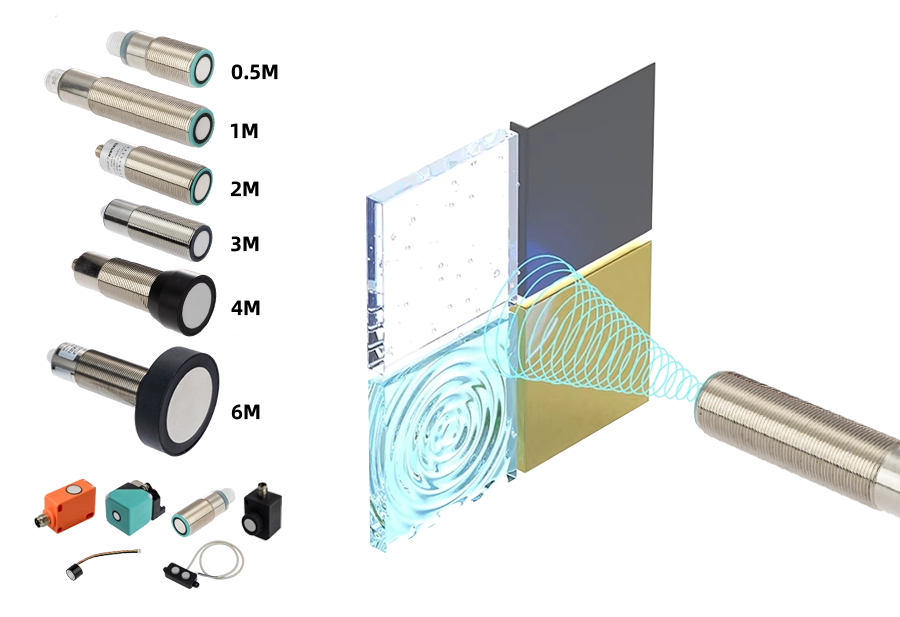
Ultrasonic Sensor Series
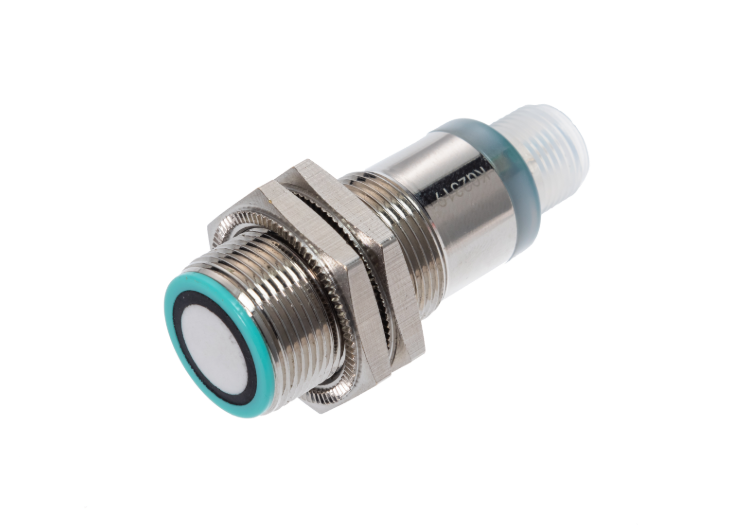
Distance Sensors
Material level detection, liquid level detection, AGV obstacle avoidance, etc.
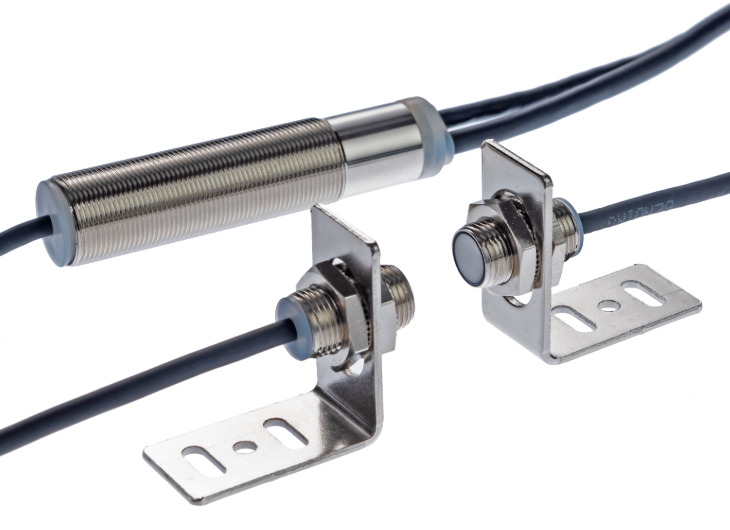
Energy Sensors
Single and double sheet detection, edge detection and correction, object material detection, etc.
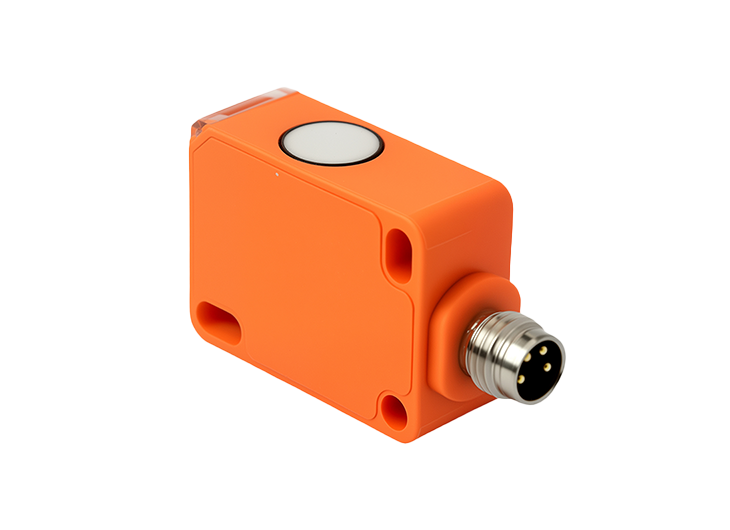
Proximity Switches
Presence detection of objects of different colors, etc.
Ultrasonic Distance Sensors
Our industrial ultrasonic sensors and ultrasonic distance sensors achieve non-contact distance and displacement detection by measuring the time of flight of ultrasonic echoes. They are insensitive to the color, material, surface reflectivity, and transparency of the target object. These sensors are particularly suitable for tank level monitoring (including liquid surfaces, slurries, powders, and granular materials), warehouse and stacking height management, access control and barrier position control, as well as obstacle avoidance, deceleration, and docking for AGVs/AMRs, functioning perfectly as an ultrasonic sensor for robot applications.
This subcategory includes various models for liquid level measurement, acting as a reliable ultrasonic level sensor or ultrasonic water level sensor. They offer a versatile ultrasonic sensor range of approximately 0.5–6 m (multiple specifications available). The sensors feature a small blind zone, millimeter-level resolution (ideal when you need a high resolution ultrasonic sensor), and good repeatability. Both narrow and wide sound beams are available to accommodate long range distance sensor needs and short-distance obstacle avoidance, enabling reliable obstacle detection using ultrasonic sensing.
ISSR high accuracy ultrasonic sensor models incorporate built-in temperature compensation and adaptive gain/filtering, and support window detection, background suppression, and crosstalk immunity. Stable distance measuring sensor output is maintained even when multiple units operate simultaneously at close range. A variety of interfaces are available, including 4–20 mA / 0–10 V analog outputs (functioning as an ultrasonic level transmitter), PNP/NPN switching outputs, and digital outputs (such as TTL232), as well as a detection range learning function.
Featuring a compact housing with high protection and contamination resistance (e.g., optional IP67/IP68), they serve excellently as a waterproof ultrasonic sensor or water resistant ultrasonic sensor. Certain models are also available with chemically resistant surfaces, making them suitable for outdoor and corrosive environments, and can even be adapted as an underwater ultrasonic sensor in specific enclosures.
Overall, this product series offers broad ultrasonic sensor applications, helping users quickly build stable and traceable non-contact distance sensor and level measurement solutions under a wide range of operating conditions.
-
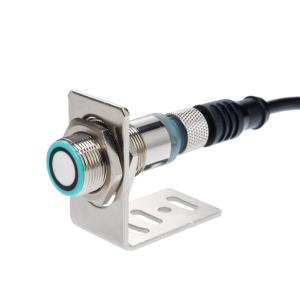
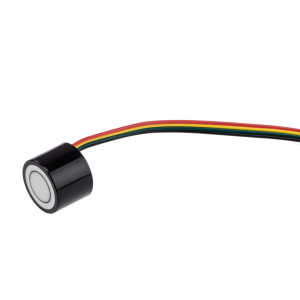
ISSR 0.15M 400kHz Ultra-high Precision Short-Form Ultrasonic Distance Sensor
-
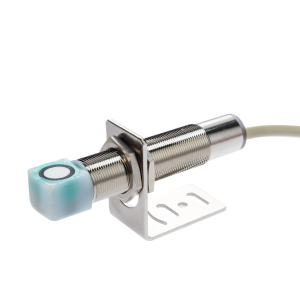
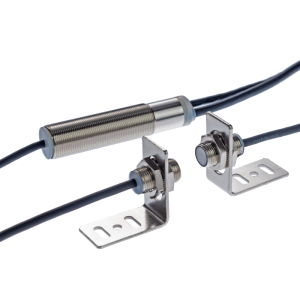
ISSR 1M 200kHz Right Angle 90-Degree Bend Fully Integrated Ultrasonic Distance Sensor
-
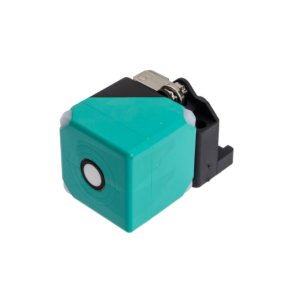
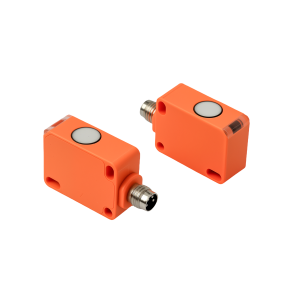
ISSR 1M 200kHz Square Adjustable Detection Direction Ultrasonic Distance Sensor with Synchronization Function
-
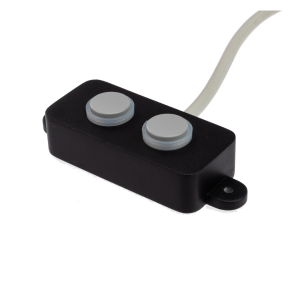
ISSR 1M 58khz Ultrasonic Distance Sensor for Robotics and Smart Bins
-
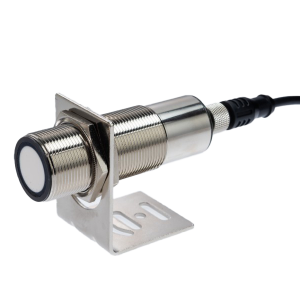
ISSR 3M All-in-One Ultrasonic Level Sensor | Analog/Switching/Digital
-
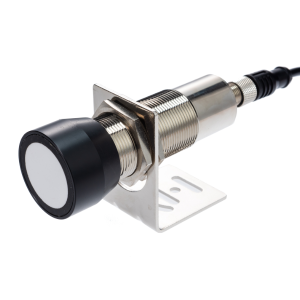
ISSR 4M All-in-One Ultrasonic Level Distance Sensor Switch/Analog/Digital Output
-
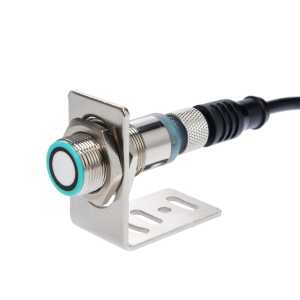
ISSR 500mm High Precision Short Range Ultrasonic Distance Sensor|200kHz
-
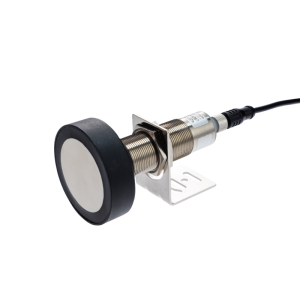
ISSR 6M Ultrasonic Level Sensor|Multi-Output Analog/Switching/Digital
-
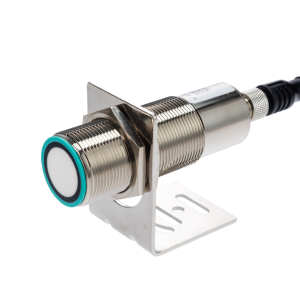
ISSR All-in-One 500MM Ultrasonic Sensor: Switch, Analog & Data Output
-
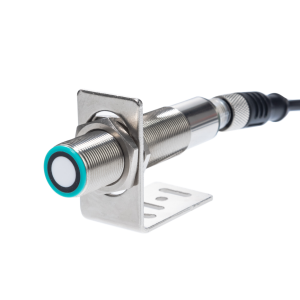
ISSR All-in-One Ultrasonic Sensor: 1m Range Level & Object Detect
-
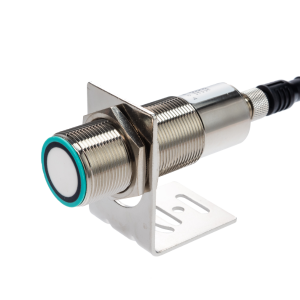
ISSR Full-Integrated 2M Ultrasonic Liquid Level Sensor
-
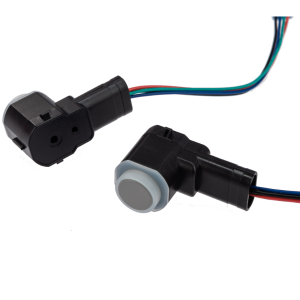
ISUB1000-17GKW29: 1M 58kHz Ultrasonic AGV Obstacle Avoidance Sensor
Ultrasonic Energy Sensors
Ultrasonic energy sensors reliably identify material layers, edge positions, and material types by monitoring changes in acoustic energy transmission and attenuation (rather than relying on optical contrast). They are unaffected by printed colors, patterns, gloss, and transparency.
They are widely used in printing and packaging production lines, metal/paper feed protection, and roll-to-roll processing, with rapid response supporting high-speed roll-to-roll transport and consistent quality control. This subcategory includes: dual-sheet detection sensors (to prevent simultaneous feeding of two sheets of paper), edge detection/correction sensors for roll guiding and misalignment control, and material detection sensors for distinguishing or confirming media such as films, paper, foil, nonwovens, and composites.
Many models support simple learning setup, automatic temperature/drift compensation, seamless integration with PLCs, and traceable process monitoring. Compact through-beam or reflective form factors, alignment aids, and robust housings further simplify machine retrofitting and long-term, easy-to-maintain operation.

Ultrasonic Proximity Switches
Ultrasonic proximity switches Sensor provide non-contact presence and position detection, remaining stable in various targets and environments. They excel in applications such as parts counting on conveyor belts, position confirmation at assembly stations, low/full stock indication in bins and hoppers, and open/close status feedback on doors or baffles. Because they rely on acoustic reflection rather than optical contrast, they are largely insensitive to target materials, colors, surface finishes, or transparency—generally outperforming traditional photoelectric sensors on glass, thin films, polished metals, and other complex surfaces. As a subcategory specifically designed for presence detection, these devices offer adjustable detection distance range learning, enabling rapid, application-specific setup, thereby improving field adaptability and enhancing production line reliability.
Comprehensive Guide to Ultrasonic Sensing Technology
If you are exploring automation solutions, you might ask: what is an ultrasonic sensor, and exactly what does an ultrasonic sensor do? In simple terms, it emits high-frequency sound waves and measures the echo return time. Because it relies on sound, this technology is highly immune to target color or transparency.
For engineers wondering “what is a ultrasonic sensor used for?”, the core advantages of ultrasonic sensor technology lie in its versatility.
Distance & Proximity Measurement
When used as a distance sensing sensor, the device excels in determining exact positions. By calculating the ultrasonic sensor distance measurement (or ultrasonic transducer distance measurement), systems achieve high-precision control. We offer various distance sensor types. Standard distance sensors offer reliable short-range detection, but if you need a wider reach, a long range ultrasonic sensor (or ultrasonic sensor high distance model) is ideal. The proximity sensor distance and sensing distance of proximity sensor are fully adjustable, making an ultrasonic sensor robot integration crucial for safe AGV navigation.
Liquid Level & Tank Monitoring
Beyond acting as a standard proximity device, these sensors are widely utilized as an acoustic level sensor, an ultrasonic level transducer, or a level ultrasonic sensor.
For liquid applications, an ultrasonic liquid level sensor acts as a robust level transmitter. An ultrasonic level transmitter (also known as a liquid level transmitter or level transmitter ultrasonic) provides continuous monitoring. Implementing an ultrasonic tank level sensor is the foundation of any reliable tank level monitoring system. Our continuous level transmitter lines integrate seamlessly into remote tank level monitoring and IoT tank level monitoring setups. Whether you are building a water tank level monitor, a comprehensive water tank level monitoring system, or performing general tank level monitoring, our ultrasonic level transmitters and tank level sensor ultrasonic models deliver consistent data.
Explore more knowledge
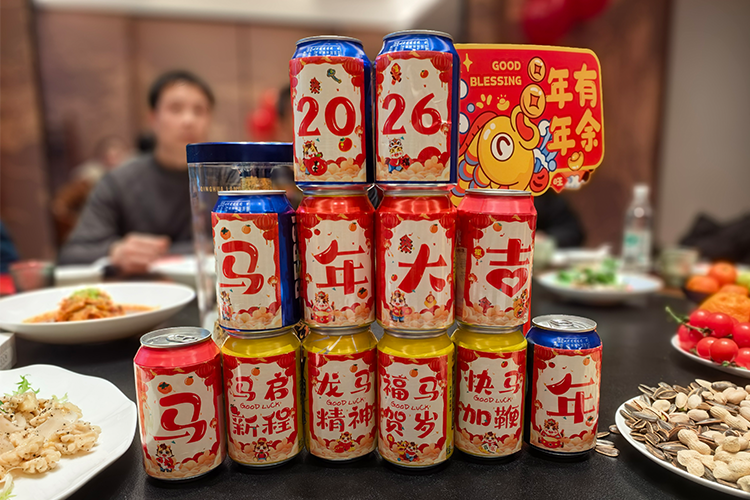
February 10, 2026, Chengdu Intelligent Sensor and System Technology Research Co., Ltd. (ISSR) successfully hosted the “Galloping to Innovation, Conquering the New Era” themed 2025 Year-End Gala at Jingrong Lake Sports Park and nearby restaurants. As an innovative enterprise specializing in the design, development, and market promotion of sensors and transducers, ISSR has always formed…
Automated material handling is increasingly demanding higher fleet density and higher vehicle speeds. As Automated Guided Vehicles (AGVs) and Autonomous Mobile Robots (AMRs) evolve into highly complex, dynamically routing machines navigating narrow aisles, their safety architecture must evolve in tandem. For years, the robotics industry has heavily relied on 2D LiDAR scanners for both simultaneous…
Need more information?
We can quickly provide customers with product information, technical support and customized services.
Frequently Asked Questions
Ultrasonic sensor is an intelligent sensor that uses high-frequency sound waves (typically above 20kHz) to achieve non-contact detection and ranging. It converts electrical signals into sound pulses through an internal piezoelectric transducer and receives the reflected echo signals, accurately calculating the distance to the target based on the time-of-flight (ToF) of the sound waves. This principle allows ultrasonic sensors to perform stable and reliable measurements in air, liquids, and even some solid media.
Compared to sensing technologies such as lasers, infrared, vision, and microwaves, ultrasonic sensors have unique advantages in environmental adaptability and versatility. They are not dependent on light and are therefore unaffected by the surface color, reflectivity, or transparency of the target object;
They maintain good measurement accuracy even in complex environments such as strong light, darkness, smoke, dust, and high humidity.
Compared to laser sensors, they are lower in cost, simpler in structure, and easier to maintain; compared to infrared sensors, they are more stable and have a wider ranging range; compared to vision sensing systems, they do not require image processing algorithms, have stronger anti-interference capabilities, and faster response speeds; and compared to microwave radar, ultrasonic sensors offer higher resolution and lower energy consumption in short-to-medium range detection.
For this reason, ultrasonic sensors are widely used in industrial automation, liquid and material level measurement and control, robot obstacle avoidance, intelligent transportation and smart homes, becoming a cost-effective ranging solution that balances accuracy, stability and economy.
Ultrasonic sensors measure distance by emitting high-frequency sound waves (typically above 20kHz) and measuring the time it takes for the sound waves to reflect back from an object. An internal piezoelectric transducer converts an electrical signal into ultrasonic pulses, which are then converted back into electrical signals upon receiving the reflected echo. By calculating the time of flight (ToF, the time difference between transmission and reception), the distance between the sensor and the target object can be accurately calculated.
Because ultrasonic sensors use sound waves, not light waves, they are unaffected by object color, surface material, or lighting conditions. They maintain stable and reliable measurement performance even in dusty, dark, humid, or complex lighting environments.
Ultrasonic sensors can be widely used in various scenarios requiring non-contact ranging and detection. Typical applications include:
– Ranging: Achieving precise distance measurement of target objects;
– Liquid/Material Level Detection: Used for height monitoring and control of liquids, powders, or solid materials in tanks, silos, or pipelines;
– Obstacle Avoidance and Collision Prevention: Applied to automatic obstacle avoidance functions in intelligent systems such as robots, AGVs, trolleys, and unmanned equipment;
– Object Detection: Identifying the presence or absence of objects on production lines or conveyor belts;
– Double Sheet Detection: Detecting double sheets or overlapping sheets in printing, packaging, and labeling processes;
– Edge Detection and Correction: Used for edge position monitoring and correction of continuous materials such as rolls, films, and paper;
– Roll Diameter Control: Real-time detection of roll diameter changes in processes such as winding, unwinding, and rewinding to achieve constant tension control;
– Material Detection: Differentiating the surface characteristics of different materials, such as differences in hardness, sound absorption, or reflectivity.
With their insensitivity to ambient light, dust, and surface color, ultrasonic sensors offer stable and reliable performance advantages in fields such as industrial automation, logistics inspection, smart devices, packaging and printing, and security systems.